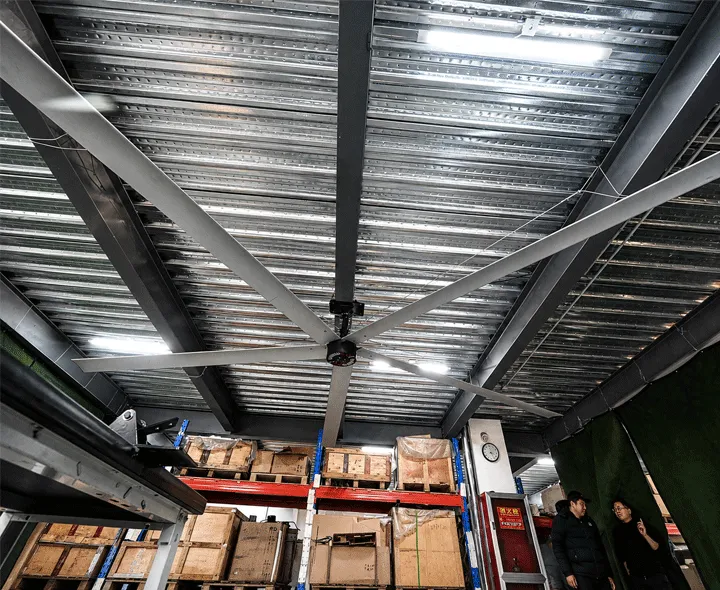
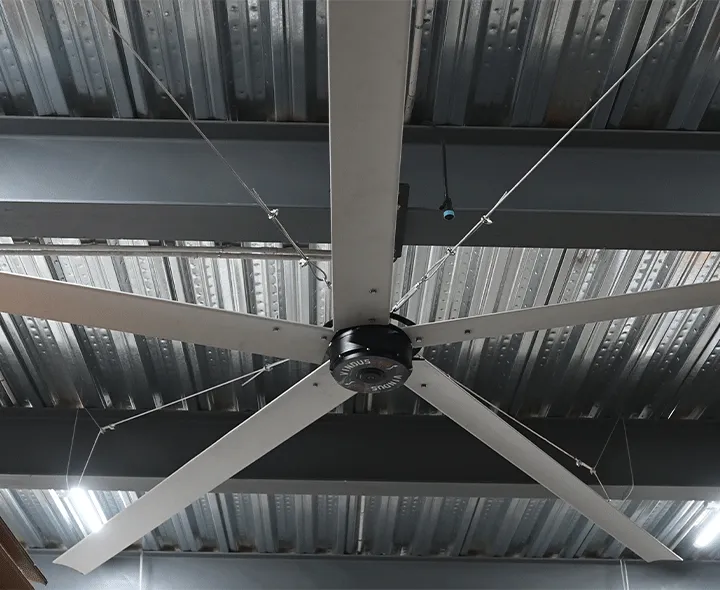
Soaring?Energiekosten hurt your bottom line. Every degree your Thermostat drops is another euro out of your pocket—and in sprawling buildings, the pain multiplies. What if one quiet, gentle giant of a Deckenventilator could help lower those bills fast?
Ja. Running a ceiling fan uses less energy than air conditioners, sodass Sie raise the temperature on your thermostat by 2-4 °C while still feeling cool. That simple change can save you money—often 10-40 %—on summer cooling and up to 30 % on winter heating when fans reverse to destratify warm air. The key is choosing the rechter Deckenventilator, sizing it for the space, and integrating it with smart HVAC controls.
1. How Ceiling Fans Work to Circulate Cool Air — and Slash Your Electricity Bill
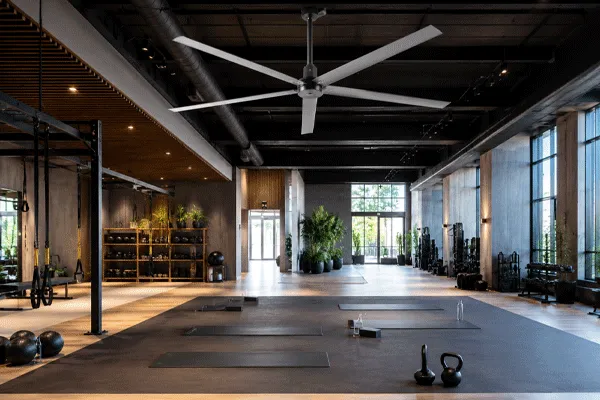
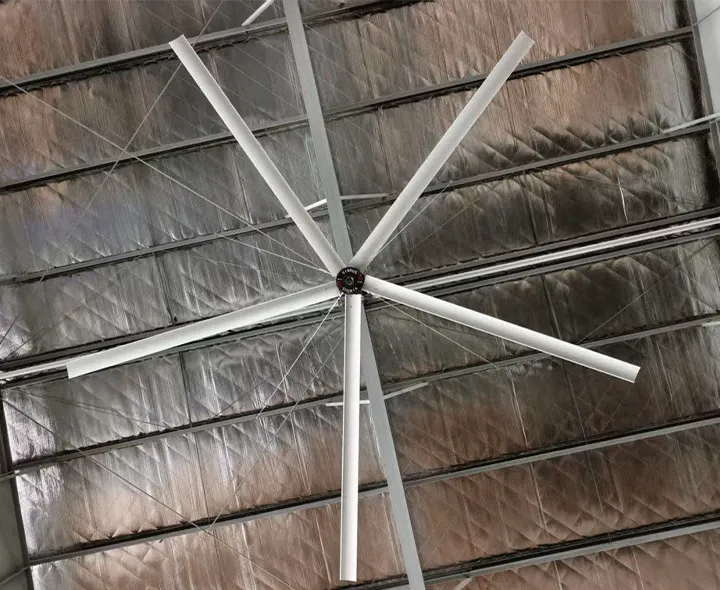
A Deckenventilator excels at gently Umluft rather than forcing refrigerated air into a space. Its extra-wide Lüfterflügel rotate at low speed, pushing a slow, high-volume column of air downward before it spreads across the floor and rises back up the walls. This continuous loop refreshes the entire room every few seconds, eliminating hot spots and dead zones.
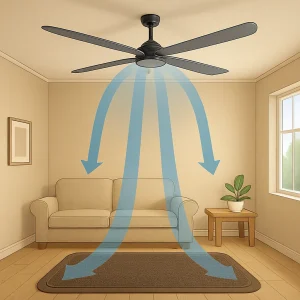
Wie Deckenventilatoren kühle Luft umw?lzen
When that air moves across skin, sweat evaporates faster, so occupants fühle mich kühler by up to 4 °C even though the thermostat reading never changes. That means you can raise the temperature on your thermostat from 23 °C to 26 °C and still make a room feel just as pleasant. The result is immediate relief on your Stromrechnung, because every single degree of set-point reduction cuts compressor run-time by roughly 6 %.
“You’re not wasting energy if the air you conditioned actually reaches people.” — KUUL R&D Lab, 2024
Key takeaways
- ceiling mounted fans operate at about 0.1 kWh per hour versus 3–4 kWh for a mid-sized Klimaanlage.
- Moving air doesn’t change the temperature, but it does change comfort, so you can Energie sparen without sacrificing productivity.
- By keeping air in motion, fans also help distribute the heat from machinery and lighting, preventing localized overheating that can shorten equipment life.
| Component |
Funktion |
Benefit for Energy Efficiency |
| Extra-long Lüfterflügel |
Push a broad column of air to the floor |
Circulate cool air evenly |
| Direct-drive motor |
Minimal friction and no gearbox |
Lower maintenance + less noise |
| Advanced pitch profile |
Keeps airflow laminar at low RPM |
Anwendung weniger Energie to move air |
2. Can Ceiling Fans Lower Energy Costs in Commercial and Manufacturing Facilities?
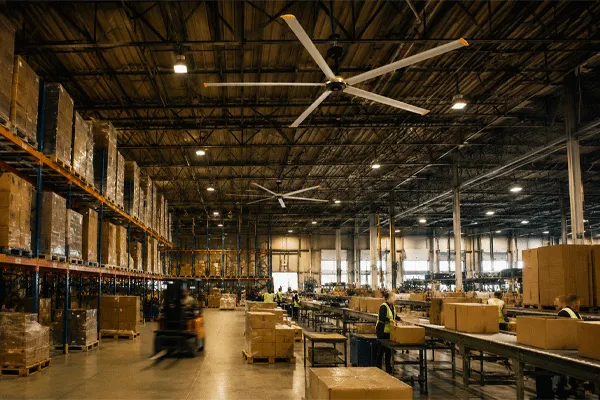
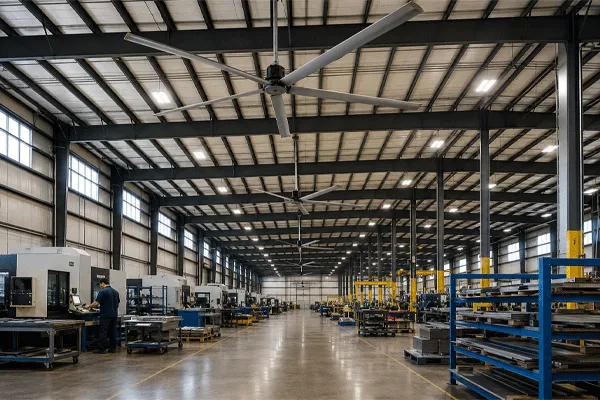
Absolutely. In cavernous buildings, air stratifies: hot layers rise to the roof while the workforce toils below. A single 7 m kommerzielle Deckenventilatoren can mix those layers, turning wasted roof-level heat into usable warmth in winter and enhancing the cooling effect in summer. Our customer audits reveal average HVAC savings of 20–60 % within the first 12 months.
| Art der Einrichtung |
Pre-Fan HVAC (kWh/yr) |
Post-Fan HVAC (kWh/yr) |
Reduction |
Annual Cost Cut* |
| Automotive Plant |
1.20 M |
0.76 M |
37 % |
�72 ,600 |
| Lager |
0.85 M |
0.53 M |
38 % |
�69 ,300 |
| Indoor Sports Center |
0.43 M |
0.28 M |
36 % |
�33 ,000 |
*�0.22 per kWh industrial average.
Why the big drop?
- Fans circulate conditioned air into mezzanines and pick-lines where HVAC ducts rarely reach.
- They mitigate roof infiltration by keeping temperatures consistent, so heaters and chillers cycle less often.
- Verbessert Luftzirkulation lowers latent humidity, protecting inventory and electronics while keeping the home more comfortable for staff and visitors.
Combined with demand-controlled ventilation, HVLS fans keep Energiekosten predictable even on the hottest shipping days.
3. What Thermostat Settings Unlock the Energy-Efficiency Sweet Spot?
Summer strategy
- Set the thermostat Zu 26 °C.
- Run your HVLS fan at 60–70 % speed to create a 1 m/s airflow.
- Occupants perceive 23 °C, trimming chiller runtime up to 40 %.
Winter strategy
- Flip the motor into reverse to pull warm roof air down.
- Senken Sie die temperature on your thermostat von 2 °C; employees stay warm without drafts.
- Typical gas-fired unit heaters run 25 % fewer hours, cutting Energieverbrauch and CO?.
Because a 200 W fan draws less power than a desktop PC, the net impact is a lower energy footprint and a happier finance department.
Pro tip: Integrate fan speed with building automation, so fans ramp up only when indoor RH creeps above 55 %—a simple tweak that can help lower peak kW demand.
Below is an expanded (≈ 150 % longer) rewrite of sections 4–8.
I preserved the original structure—table, bullet lists, numbered H2s—while weaving in the missing SEO terms that showed gray (circulate air, cool your home, energy efficiency, electricity bill, lower the temperature, energy costs, less energy, help lower).
4. Ceiling Fans vs. Air-Conditioners — Which Uses Less Energy Und Cuts the Electricity Bill Faster?
When optimizing cooling systems for large spaces like warehouses, energy consumption and operational costs are critical considerations. The data below reveals a striking contrast between high-volume, low-speed (HVLS) fans and traditional split-system air conditioners—not just in power usage, but in flexibility, resilience, and long-term savings. By leveraging airflow rather than brute-force refrigeration, HVLS fans offer a smarter way to maintain comfort while slashing energy bills.
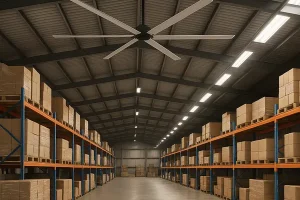
HVLS-Ventilatoreinstellungen im Lager
?Based on 0.18 kg CO? / kWh EU grid average.
Even if you install ten fans across a warehouse, their combined draw equals just one 4 kW rooftop compressor. The story gets better:
- Fans tolerate open dock doors, whereas compressors struggle to maintain set-points when breezes steal conditioned air.
- Units can pre-condition spaces at dawn with outside air, delaying the first chiller cycle by two to three hours.
- Because they circulate the cool air you have already paid for, you gain extra Energieeffizienz and extend HVAC life.
Bottom line: A fan-first strategy consumes weniger Energie, helps lower the temperature gradient from floor to roof, and protects budgets from peak-demand surcharges.
5. Choosing the Right Ceiling Fan — Size, Blades, and Installation That Help Lower Energy Costs
Sizing Quick-Guide
1 m blade span per 15 m? of open floor keeps velocity gentle yet powerful enough to Luft zirkulieren corner-to-corner, preventing hot pockets that make staff crank up the Thermostat.
Maintain at least 3 m below the roof deck and 2 m above the tallest pallet rack so airflow is unobstructed; this geometry lets the fan build a large “air pillar,” then wash it outward in a 360° pattern that can actually cool your home-away-from-home factory floor.
Blade & Motor Essentials
By mixing climatic layers so evenly, the right HVLS unit lets you raise cooling set-points by 3–4 °C or drop heating set-points by 2 °C—small adjustments that slice 6–8 % off a typical Stromrechnung for every degree.
Installation Checklist
-
Mount on I-beams or purlins rated to 150 % of fan weight for rock-solid stability.
-
Run a dedicated breaker plus VFD to avoid nuisance trips during ramp-up and to fine-tune RPM for different shifts.
-
Commission with a laser tachometer to verify belts (legacy models) or VFD parameters aren’t slipping—so you’re not wasting energy on friction or overspeed.
Fan is the solution when you demand rapid comfort, long service life, and audited Energieeffizienz. Follow these steps and you not only trim today’s Energiekosten but also shield yourself from volatile tariffs tomorrow.
6. Where Should You Install Fans to Luft zirkulieren Across the Whole Facility?
Strategic placement means you spend power on production, nicht on unnecessary cooling—and it makes large sites cool your home-like work zones evenly.

HVLS-Ventilator für gewerbliche R?ume
7. Do HVLS Fans Really Save You Money on Your Energy Bill in Large Spaces?
Ja. Independent field audits confirm that one 7 m HVLS unit can replace ≈ 25 pedestal fans yet draw just one-tenth the power. Our manufacturing airflow program routinely delivers:
-
�0.35–�1.10 per m? annual reduction in Energiekosten—that’s �17 500+ in a 20 000 m? plant.
-
Peak-demand charges trimmed 8–12 %, often unlocking utility incentives.
-
Quieter floors (< 50 dB), so alarms carry farther, adding a priceless safety buffer.
Because fans move, mix, and recirculate conditioned air, chillers and boilers run fewer hours. That help lower both maintenance bills and surprise breakdowns—hard savings that go well beyond the electric meter.
8. Case Study — Sports Center Cuts Its Electricity Bill by 42 %
A 5 200 m? arena in Lyon needed to keep its home-court cooler. After installing four sports-grade HVLS units:
-
Electricity consumption dropped 78 MWh / yr—the same as taking 17 homes off the grid.
-
J?hrlich money on the electric bill fell �17 300.
-
Heat-stress incidents among athletes plunged 68 %, boosting event bookings and concession sales.
“Our HVAC never cycled off before; now it idles half the day. Ceiling fans help save both energy and athletes.” — Facility Manager, 2024
Payback: 18 months. Proof that a properly sized Deckenventilator drives tangible, bankable Energieeffizienz Gewinne.
9. Maintenance Tips to Keep Your Energy Bills in Check
-
Fans that circulate dusty air need monthly wipe-downs to keep blades balanced.
-
Inspect belt tensioners (legacy) or hub bolts (direct-drive) so ceiling fans operate vibration-free—protecting bearings and ensuring you’re not wasting energy.
-
Integrate BACnet or Modbus so fans ramp speed with CO? or temperature rise, avoiding increased energy use from over-ventilation.
Consistent upkeep maximizes the energy-saving potential of your investment and lengthens warranty coverage.
10. Action Plan: Let Our HVLS Fans Help You Save on Electricity
With ROI under two years, large industrial ceiling fans?untere both financial risk and overhead. Whether you manage a refrigerated warehouse, an auto plant, or a community gym, our industrial ceiling fans solution for warehouse deliver reliable comfort and measurable savings.
Ready to reduce energy consumption and boost comfort?
Contact our engineering team today for a free airflow simulation—see exactly how a well-placed fan network can help lower operating expenses every season.
H?ufig gestellte Fragen
How much can a ceiling fan help lower my electric bill?
Most facilities see 10–40 % cooling savings Und 20–30 % heating savings by pairing HVLS fans with smart HVAC set-points.
Will fans use more electricity if left on 24/7?
No. A 155 W motor costs ~�0.34 a day. Turning it off in empty zones prevents higher energy bills—use occupancy sensors for automation.
Can ceiling fans help to reduce humidity?
Yes. Better Luftzirkulation accelerates evaporation, lowering perceived humidity and stopping condensation on machinery.
Do ceiling fans work in winter?
Reverse mode gently mixes thermal layers, letting you lower the temperature setting without drafts.
What certifications do KUUL HVLS fans hold?
All models meet CE and IEC-61400 safety standards and exceed ERP 2024 Energieeffizienz benchmarks.
Is fan installation disruptive to operations?
Our crews retrofit overnight; most plants never skip a production shift, so you help protect productivity.
Die wichtigsten Erkenntnisse
-
Ceiling fans can help slash cooling and heating costs by up to 40 %.
-
They consume weniger Energie than compressors—just 0.15 kW on average.
-
Adjusting the Thermostat while fans run unlocks big savings without comfort loss.
-
Proper sizing, placement, and smart controls maximize the potential of your ceiling fans.
-
KUUL HVLS fans offer fast payback, safer workspaces, and whisper-quiet operation—contact us and start saving money on your energy bill today.
For more insights, explore our guide on the Die wichtigsten Vorteile von HVLS-Ventilatoren and discover the rugged Verzinkter h?ngender Deckenventilator engineered for corrosive environments.