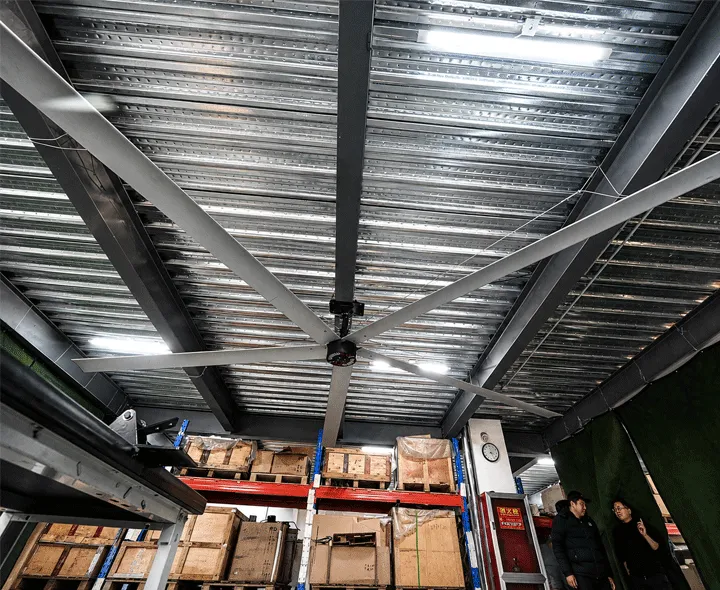
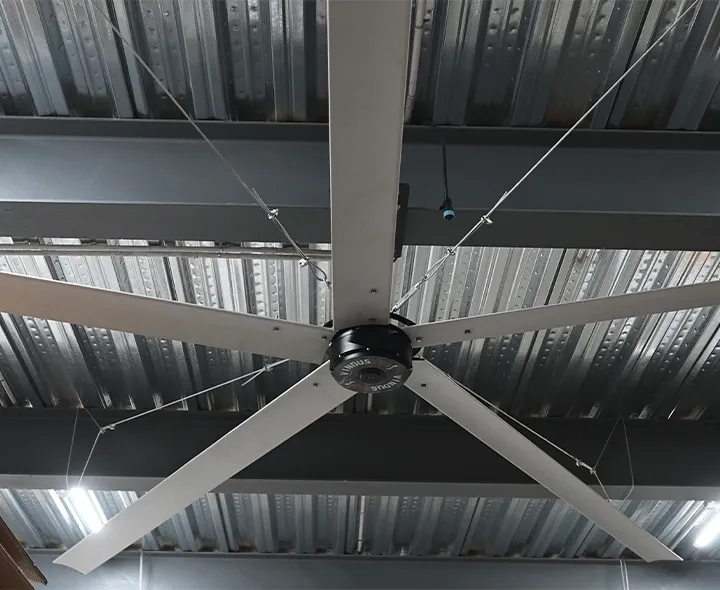
Choosing the right gym fan is not simply about moving more air. It is about creating a comfortable training environment, controlling operating costs, and selecting equipment that can handle long operating hours. This guide compares HVLS fans, ceiling fans, floor fans, and other commercial options to help fitness center owners make a better investment.

Best Fans for Gyms: Comparing HVLS Ceiling Fans and Industrial Fans for Fitness Centers
1. Why Do Large Gyms Need More Than Traditional Ceiling Fans?
A large gym has different cooling needs from a home gym or small workout room. It may contain cardio machines, weight training areas, group exercise studios, basketball courts, and spectator seating. Each area has different activity levels and airflow needs.
Traditional ceiling fans, box fans, and small oscillating fans can help in limited areas. However, they often struggle to provide even air movement across a large commercial gym. Multiple small units can also create uneven airflow, occupy useful space, and increase maintenance work.
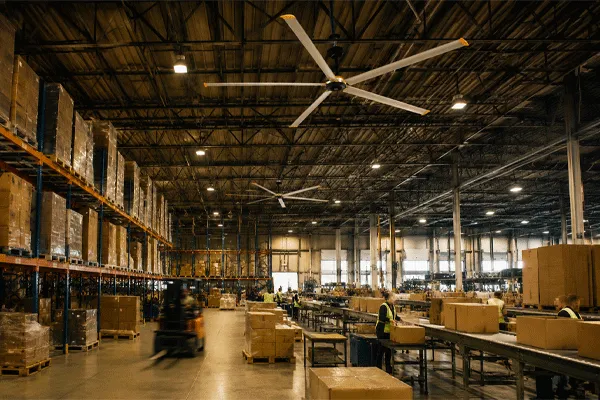
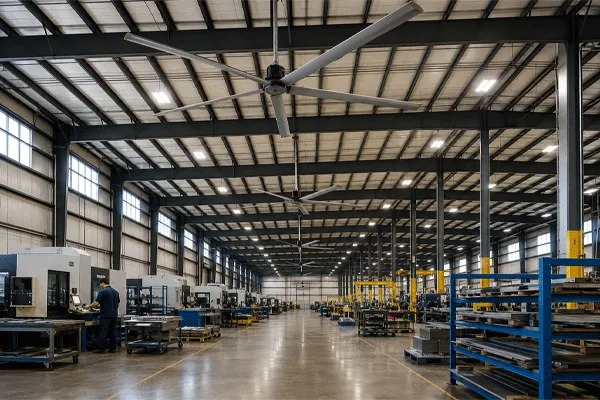
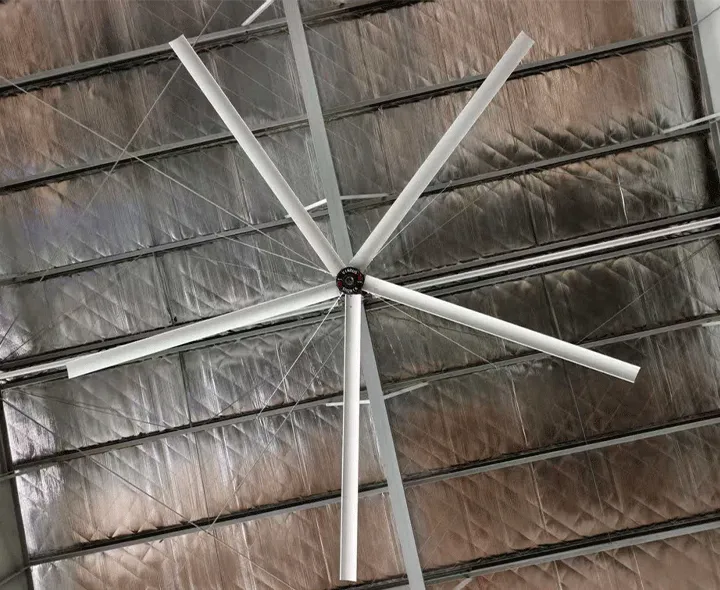
HVLS (High-Volume Low-Speed) fans offer another approach. They use large blades that rotate at relatively low speeds to move a high volume of air across a wide area. Instead of creating a strong, narrow stream, an HVLS fan helps distribute air throughout the fitness space.
For a gym owner, the main benefits include:
-
More even air movement across the gym floor.
-
Better thermal comfort during exercise.
-
Reduced stagnant air and moisture buildup.
-
Support for existing HVAC and air conditioning systems.
-
Lower fan energy consumption compared with operating many smaller fans in some applications.
The goal is not simply to install a large fan. It is to select a system that matches the building and daily activities.
2. HVLS Ceiling Fans vs. Floor Fans: Which Is Better for Gyms?
There are several types of fans used in fitness facilities. Each has a different purpose.
| Type de ventilateur |
Main advantage |
Main limitation |
Best application |
| Ventilateur de plafond HVLS |
Wide, even air movement |
Requires suitable ceiling height and structural support |
Large gyms and sports halls |
| Traditional ceiling fan |
Simple installation |
Couverture limitée |
Small workout rooms |
| Ventilateurs sur pied |
Adjustable direction |
Occupies floor space |
Local cooling |
| Drum fan |
Strong directional airflow |
Can create concentrated drafts |
Temporary cooling and work areas |
| Ventilateurs muraux |
Keeps floor space clear |
Couverture limitée |
Smaller training zones |
| Industrial floor fan |
High-velocity airflow |
Requires floor space and careful positioning |
Targeted cooling |
A floor fan can be useful when a specific exercise area needs extra air movement. However, it may interfere with equipment layouts, cleaning, and member movement. Pedestal fans also need regular positioning adjustments.
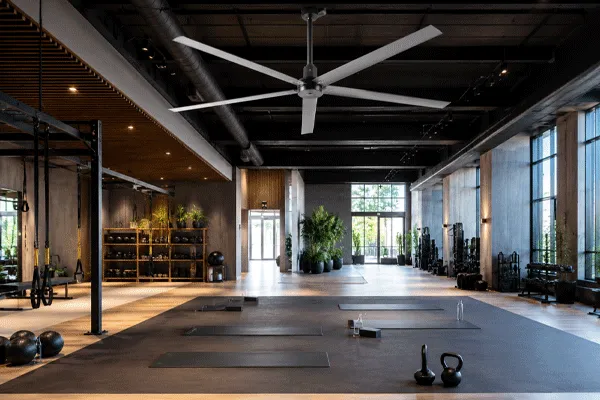
An HVLS ceiling fan works differently. It stays above the activity area and distributes air over a much wider coverage area. This makes it a practical choice for large spaces where floor-mounted equipment is not ideal.
My recommendation: Use an HVLS fan as the main air circulation solution for suitable large gyms. Add smaller fans only where a specific local airflow need exists.

Best Fans for Gyms: Comparing HVLS Ceiling Fans and Industrial Fans for Fitness Centers
3. What Are the Best Fans for Different Types of Fitness Facilities?
Not every fitness center needs the same fan system. A large sports complex has different requirements from a private training studio.
Large commercial gyms
Large commercial gyms often have high ceilings, open floor areas, and long operating hours. Big ceiling fans can move air across workout areas without taking up floor space.
For these buildings, HVLS gym ceiling fans are worth evaluating first. Their coverage and low-speed operation make them suitable for large commercial applications.
Weight training and cardio facilities
Cardio machines generate body heat during exercise, while strength training areas have different patterns of activity and rest. Consistent air movement helps improve comfort without directing an excessive stream of air at every machine.
Basketball courts and indoor sports halls
Sports halls need to consider more than cooling. Air movement can affect lightweight balls, shuttlecocks, and other sports equipment.
A good fan layout should account for playing surfaces, ceiling height, lighting, and suspended equipment.
Small fitness studios and home gyms
Smaller spaces may not need a large industrial fan. A traditional ceiling fan, wall-mounted fan, or compact ventilation system may be more suitable.
The important point is to avoid choosing big fans simply because they look impressive. The right solution depends on the building.
4. How Do You Compare HVLS Fan Models for a Large Gym?
Fan diameter and installation height are two important factors when choosing an HVLS fan. A larger fan is not automatically better. It must match the available ceiling clearance, mounting conditions, and required coverage.
VINDUS offers several industrial ceiling fan models for different building sizes.
| Series |
Diameter options |
Suitable ceiling height |
Typical application |
| P680 |
8–14 ft |
10–25 ft |
Smaller commercial gyms and training areas |
| P730 |
16–18 ft |
20–33 ft |
Large gyms and sports facilities |
| P780 |
20 à 24 pieds |
20–33 ft |
Large sports halls and open commercial spaces |
These are product selection ranges, not a substitute for a project-specific layout.
The P730 Series uses a permanent magnet synchronous motor and direct-drive design. It is available in 16 ft and 18 ft configurations, with maximum power ratings of 450 W and 460 W respectively. The P780 Series provides 20 ft and 24 ft options for larger spaces.
Explore the actual product specifications:
When comparing models, check:
-
Available diameter and blade design.
-
Recommended mounting height.
-
Maximum and normal operating power.
-
Motor and drive technology.
-
Safety features and structural requirements.
-
Control options and maintenance access.
A properly sized HVLS fan covers the intended area without creating unnecessary overlap or airflow problems.
5. What Airflow and Performance Data Should You Request?
One common mistake when buying a gym fan is comparing products only by diameter or advertised coverage.
A large fan may look impressive, but its real value depends on how effectively it moves air at the operating speed you plan to use.
Ask suppliers for the following information:
| Performance factor |
Why it matters |
| Débit d'air (CFM) |
Shows the volume of air moved |
| Air velocity |
Helps evaluate air movement at occupant level |
| Consommation d'énergie |
Helps estimate electricity costs |
| Operating speed (RPM) |
Shows how the fan performs at different settings |
| Sound measurement |
Important for classes and instructor communication |
| Coverage layout |
Shows how much usable floor area receives airflow |
| Test standard |
Helps compare different manufacturers fairly |
A reliable supplier should explain how airflow figures were measured, including the test method and operating conditions.
For commercial and industrial HVLS products, ask whether performance data follows recognized methods such as AMCA 230-15 and ANSI/ASHRAE 216P.
Also, do not confuse air circulation with fresh-air ventilation. An industrial fan moves indoor air, but it does not replace the fresh-air supply required by the building’s ventilation system.
This distinction matters when evaluating air quality in crowded fitness facilities.
6. MacroAir Fan, Big Ass Fans, or Other Manufacturers: How Should Buyers Compare Suppliers?
When searching for the best fans for gyms, buyers may encounter brands such as MacroAir and Big Ass Fans, along with other industrial ceiling fan manufacturers.
Brand recognition is useful, but it should not be the only factor in your decision.
A gym project requires equipment that matches the building, installation conditions, operating schedule, and maintenance budget.
Here is a practical supplier comparison framework:
| Evaluation criteria |
Questions to ask |
| Product range |
Does the manufacturer offer different fan diameters? |
| Ingénierie |
Can it review ceiling height and structural conditions? |
| Performance |
Can it provide comparable airflow test data? |
| Motor design |
Is the motor direct drive or gearbox-driven? |
| Control system |
Can multiple fans operate independently? |
| Sécurité |
Are safety cables and blade retention systems included? |
| Garantie |
What components are covered, and for how long? |
| Technical support |
Is installation and after-sales support available? |
| Customization |
Can the supplier support project-specific requirements? |
If you are comparing a MacroAir fan with another manufacturer’s product, request specifications for the same operating conditions.
Do the same when evaluating Big Ass Fans and other big industrial fans.
Avoid comparing one manufacturer’s maximum airflow with another manufacturer’s low-speed operating data. The figures may not represent the same conditions.
For international B2B buyers, also check spare parts availability, delivery arrangements, electrical compatibility, and technical communication.
A dependable supplier should help you evaluate the entire project, not simply sell a fan.

Best Fans for Gyms: Comparing HVLS Ceiling Fans and Industrial Fans for Fitness Centers
7. Does Motor Technology Affect Gym Fan Operating Costs?
Yes. Motor and drive technology can influence energy consumption, maintenance requirements, and long-term ownership costs.
Traditional gearbox-driven fans may require oil and seal maintenance. Direct-drive systems remove the gearbox and its related service requirements.
VINDUS P730 and P780 models use permanent magnet synchronous motor technology with direct drive. Their product designs emphasize fewer moving parts, reduced maintenance requirements, and energy-efficient operation.
For a fitness center that operates from early morning until late evening, even small differences in daily electricity consumption can add up over time.
You should also consider intelligent controls.
The VINDUS FanBrain intelligent HVLS control system supports centralized control of up to 10 fans, scheduling, temperature-based operation, and independent group management.
These features can help a gym manage different operating schedules without requiring staff to adjust every fan individually.
8. What Should You Check Before Installing an Industrial Gym Fan?
Fan installation requires more planning than simply finding an empty position on the ceiling.
A gym may contain lighting systems, sprinkler heads, basketball equipment, suspended speakers, steel trusses, and other structures.
Before installing an industrial ceiling fan, review the following:
Building and structural conditions
-
Measure the actual ceiling height.
-
Identify the lowest structural obstruction.
-
Check the roof structure and mounting capacity.
-
Have a qualified structural engineer review the mounting loads.
-
Confirm electrical supply and control wiring.
Safety and operating conditions
-
Maintain required clearance from lights and other equipment.
-
Check sprinkler and fire protection requirements.
-
Consider the movement of basketball hoops and other suspended equipment.
-
Prevent interference with sports activities.
-
Confirm safe access for future inspection and maintenance.
A qualified engineer should review the proposed fan positions before installation.
This is particularly important in large gyms with long-span roof structures. A suitable mounting solution must account for the fan’s weight, movement, and dynamic loads.
9. How Can Gym Owners Calculate the Total Cost of Ownership?
The purchase price is only one part of the investment.
A gym owner should consider the total cost over the expected operating life of the fan system.
A useful comparison includes:
| Cost item |
What to evaluate |
| Initial equipment cost |
Fan models, quantities, and accessories |
| Installation |
Labor, lifting equipment, mounting hardware |
| L'électricité |
Actual power consumption and annual operating hours |
| Entretien |
Inspection, cleaning, and replacement parts |
| Control system |
Centralized controls and electrical integration |
| HVAC interaction |
Potential changes in cooling and heating operation |
| Garantie |
Coverage period and service conditions |
To calculate the financial benefit, compare the proposed system with your existing cooling and ventilation costs. Do not assume that HVLS fans will replace air conditioning in every climate.
The strongest business case comes from measured operating data, realistic usage assumptions, and a complete installation quotation.
10. How to Choose the Right HVLS Fan Supplier for Your Gym Project?
A good supplier should understand both fan technology and the building where the equipment will operate.
As a Sino-US joint venture manufacturer and solution provider, VINDUS specializes in HVLS fans, industrial ceiling fans, commercial ceiling fans, and intelligent airflow control systems.
We support ventilation and cooling projects across sports facilities, warehouses, manufacturing plants, commercial buildings, and agricultural environments.
For gym and fitness center projects, our product range provides different diameter options and control configurations to match different building requirements.
Before requesting a quotation, prepare the following information:
-
Building length and width.
-
Ceiling height and roof structure.
-
Available installation positions.
-
Gym floor layout and training zones.
-
Existing HVAC and ventilation systems.
-
-
Electrical supply information.
-
Preferred fan control requirements.
With these details, our team can review your requirements and recommend a suitable fan configuration.
Explore our industrial and commercial HVLS fan products ou contact VINDUS for a gym airflow solution.
We can help you move from product selection to a practical project proposal.
Questions fréquemment posées
Are HVLS fans better than traditional ceiling fans for large gyms?
HVLS fans are often more suitable for large gyms because they move large volumes of air across a wider area. Traditional ceiling fans may be more appropriate for small studios and home gyms.
Can HVLS fans replace air conditioning in a fitness center?
No. HVLS fans improve perceived cooling through air movement, but they do not lower the actual air temperature. They can support an HVAC system and may help reduce cooling demand under suitable conditions.
How many HVLS fans does a large gym need?
The number depends on building dimensions, ceiling height, obstructions, fan diameter, and required airflow. A ceiling layout and engineering review are needed before confirming the quantity.
Are industrial ceiling fans noisy during exercise classes?
Noise depends on motor design, blade aerodynamics, operating speed, and installation quality. Ask suppliers for sound measurements under clearly stated test conditions.
What is the difference between an HVLS fan and a drum fan?
An HVLS fan moves large volumes of air across a broad area at low speed. A drum fan produces more concentrated, directional airflow and is generally used for local cooling.
What information should I provide when requesting a gym fan quotation?
Provide building dimensions, ceiling height, roof structure, floor layout, existing HVAC information, operating hours, and electrical supply details. These help the supplier recommend appropriate models and installation positions.
Principaux points à retenir
-
HVLS fans are suitable for many large gyms and fitness facilities that need broad, consistent air circulation.
-
Traditional ceiling fans, pedestal fans, and drum fans serve different purposes and should not be compared only by fan size.
-
Fan diameter, ceiling height, airflow, motor technology, and installation conditions all matter.
-
Compare suppliers using verified performance data, safety documentation, warranty terms, and after-sales support.
-
Direct-drive motors and intelligent controls can help reduce maintenance needs and improve daily operation.
-
HVLS fans support HVAC systems but do not replace fresh-air ventilation or mechanical cooling.
-
A professional layout review is essential before choosing the final fan quantity and installation positions.