A hot dairy barn can have plenty of fans and still leave cows panting, bedding damp, and energy bills high. The problem is often not fan quantity but airflow design. An efficient HVLS system works best when air exchange, cow-level velocity, and controls are planned together.
Energy-efficient HVLS fans support livestock barn ventilation by moving large volumes of air across wide animal zones at low speed. They work best as part of a complete dairy ventilation system that also provides fresh-air exchange, adequate cow-level air velocity, humidity control, and targeted cooling where needed.

Energy-Efficient HVLS Fans
Plan de l'article
- Why Does Livestock Barn Ventilation Need More Than Just More Fans?
- What Airflow Do Dairy Cows Actually Need?
- How Does an HVLS Fan Work in a Dairy Barn?
- HVLS Barn Fans vs High-Speed Fans: Which Does What Better?
- How Should Natural Ventilation, Exhaust Fans, and HVLS Work Together?
- How Can Livestock Barn Fans Improve Energy Efficiency?
- Where Should HVLS Fans Be Installed in Dairy Freestall Barns?
- How Do COOL and Hunter Industrial Barn Fan Options Compare?
- Can Smart Controls Improve Dairy Barn Fan Performance?
- How Should You Choose the Right Livestock Fan System?
1. Why Does Livestock Barn Ventilation Need More Than Just More Fans?
A barn can feel windy and still have poor ventilation.
That happens because air movement and air exchange are different jobs. A livestock fan can move indoor air across cows, bedding, feed alleys, and working areas. But ventilation must also bring fresh outside air into the barn and remove heat, moisture, gases, and stale air.
This distinction is critical in dairy facilities.
University of Wisconsin Extension explains that dairy barn ventilation has two major summer functions: exchanging indoor air and creating fast-moving air around the cows. It recommends roughly 40–60 air changes per hour during summer in suitable systems, while winter exchange requirements can be much lower.
A good barn system may therefore combine:
- Natural ventilation through open sidewalls and ridge openings
- Mechanical exhaust fans
- Axial or high-speed circulation fans
- Large-diameter HVLS fans
- Soakers or sprinklers
- Automatic controls
The key lesson is simple:
Do not ask one fan type to perform every ventilation job.
An HVLS fan is very good at broad air circulation. An exhaust fan is designed to exchange air. A directed axial fan can produce higher air velocity over a particular row of cows.
Used together, these systems can create a far better barn environment than simply adding more random fans.
For a broader overview of large-farm airflow planning, see COOL’ livestock barn fan solutions.
2. What Airflow Do Dairy Cows Actually Need?
Cows generate a large amount of metabolic heat. High-producing dairy cows can become uncomfortable long before workers feel that the barn is dangerously hot.
Heat stress affects behavior first.
You may see cows:
- Breathing faster
- Standing more and lying less
- Gathering around water
- Reducing feed intake
- Bunching in shaded or cooler zones
- Panting during severe heat
University of Wisconsin Extension notes that a respiration rate around 60 breaths per minute in lactating cows is a useful warning sign that animals are struggling with heat.
That is why air velocity at cow level matters more than the airflow near the roof.
For resting areas, Wisconsin Extension recommends at least about 200 ft/min, or roughly 2.3 mph, with around 400 ft/min or 4.6 mph preferred in many hot-weather dairy situations. Measurements should be taken near the cow, approximately 20–30 inches above the stall base.
Penn State gives a similar practical range, recommending approximately 3.5–5 mph in resting, feeding, and holding areas during hot conditions.
Dairy Heat-Abatement Targets
| Design Question |
Practical Reference |
| Summer air exchange |
Around 40–60 ACH in properly designed systems |
| Minimum cow-level air speed |
About 200 ft/min |
| Preferred hot-weather range |
Roughly 3.5–5 mph |
| Key measurement location |
Around cow resting/standing level |
| Main objective |
Increase convective and evaporative heat loss |
These are engineering references, not universal settings for every barn.
Breed, milk production, stocking density, humidity, building design, outside weather, bedding system, and cooling strategy all influence the final requirement.
This is also why milk production should never be promised from a fan alone. Fan performance is one part of a complete animal-comfort program.
3. How Does an HVLS Fan Work in a Dairy Barn?
HVLS means High Volume Low Speed.
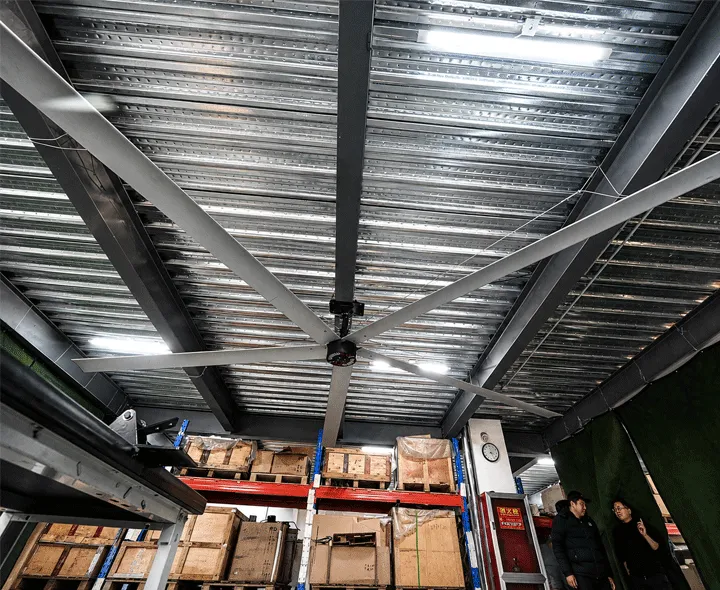
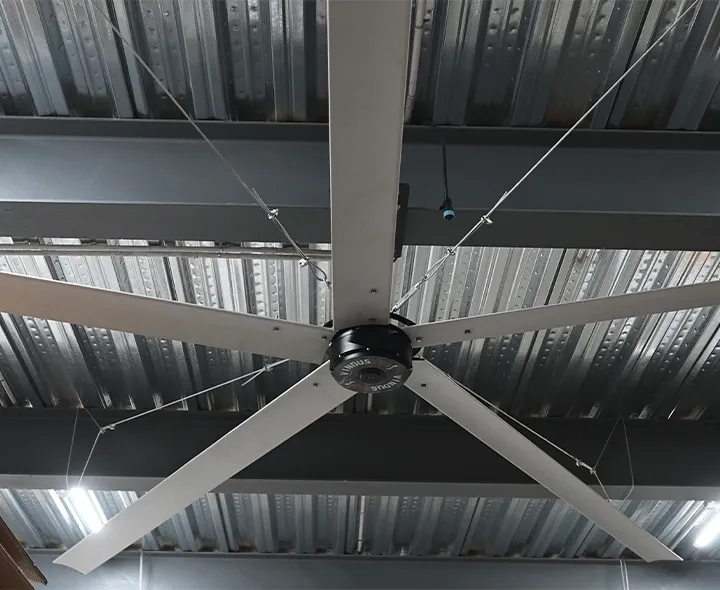
An HVLS fan uses a large diameter and relatively low rotational speed to move a broad column of air. Instead of creating a narrow blast directly in front of the fan, it distributes airflow across a much wider area.
Inside livestock barns, this can help:
- Reduce stagnant zones
- Improve broad air circulation
- Move air across alleys and resting areas
- Support surface drying
- Distribute incoming fresh air
- Mix temperature layers in tall barns
The large diameter is the key.
A smaller high-speed ventilation fan may produce much higher local air velocity, but its influence is more directional. An HVLS ceiling fan spreads air over a larger footprint.
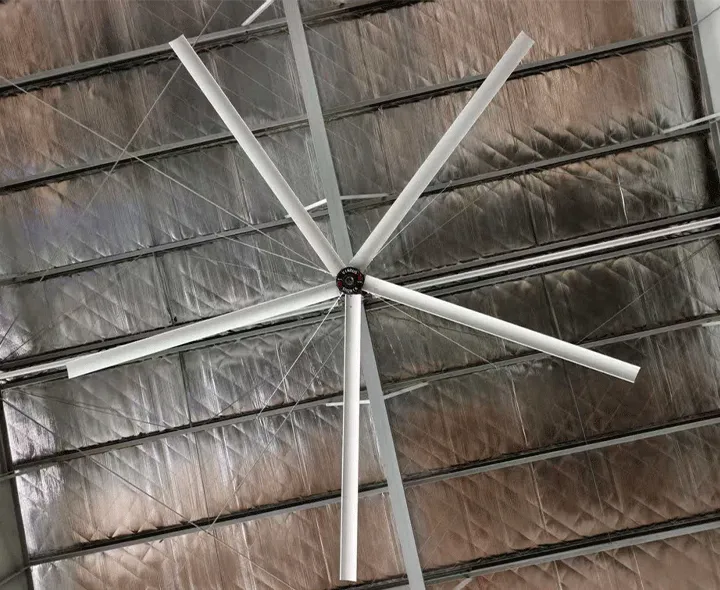
COOL uses a five-blade configuration across its main P-Series HVLS products.
For medium-size agricultural and commercial spaces, the P680 Series HVLS fan is available from 8 ft to 14 ft in diameter. Current published power use ranges from 100 W to 290 W depending on size, with five blades, adjustable mounting, IP55 protection, and variable-speed control.
For larger, higher-roof buildings, the P730 Series HVLS fan provides 16 ft and 18 ft configurations, while the P780 Series HVLS fan provides 20 ft and 24 ft options.
However, a large fan should not be selected from diameter alone. Barn geometry and cow-level air velocity still determine whether the system is suitable.

Energy-Efficient HVLS Fans for Livestock Barn Ventilation: Dairy Barn Airflow, Heat Stress, and Fan Selection
4. HVLS Barn Fans vs High-Speed Fans: Which Does What Better?
This is where many livestock fan projects go wrong.
HVLS fans and high-speed fans are not direct replacements for one another in every barn.
A high-speed axial or basket fan can create strong air velocity directly over a row of cows. This is useful when the objective is rapid convective and evaporative cooling during very hot weather.
An HVLS fan works differently.
Its strength is broad coverage and whole-zone air circulation.
Fan Type Comparison
| Type de ventilateur |
Main Strength |
Typical Barn Role |
| Ventilateur de plafond HVLS |
Broad air circulation |
Whole barn or large animal zone |
| Axial circulation fan |
High local velocity |
Stalls, feed bunk, holding area |
| Exhaust fan |
Air exchange |
Remove hot, humid, contaminated air |
| Box fans |
Local cooling |
Small temporary areas |
| Natural ventilation |
Low-energy air exchange |
Open-sided barns |
| Tunnel ventilation |
Controlled air exchange and velocity |
Enclosed dairy barns |
Penn State specifically notes that HVLS fans can provide air movement at cow level, but also states that they should normally be installed over the animals and spaced appropriately. High-speed axial fans remain useful when strong directed velocity is required.
So which is better?
Neither is universally better.
For a large open dairy barn, HVLS may provide efficient air circulation across the whole building.
For an enclosed holding pen packed with cows during a hot afternoon, high-speed directed airflow plus evaporative cooling may be more effective.
In many barns, the best answer is a hybrid design.
5. How Should Natural Ventilation, Exhaust Fans, and HVLS Work Together?
Natural ventilation can be extremely energy-efficient because wind and thermal buoyancy move the air without large mechanical exhaust loads.
Well-designed dairy freestall barns often use large sidewall openings, curtains, ridge vents, and proper orientation to take advantage of prevailing winds.
Wisconsin Extension notes that a properly oriented naturally ventilated barn may achieve around 40–60 air changes per hour on a breezy summer day. But during hot, still weather, natural airflow can become much less reliable.
That is where mechanical equipment becomes important.
A Practical Ventilation Hierarchy
Level 1 — Air Exchange
Use natural openings or mechanical exhaust to bring fresh air through the building.
Level 2 — Cow-Level Velocity
Use appropriate circulation fans to move air across the animal.
Level 3 — Whole-Barn Air Circulation
Use HVLS fans where broad air movement is needed across a large area.
Level 4 — Evaporative Cooling
Use soakers or sprinklers where climate and barn management support them.
A ventilation fan and an HVLS ceiling fan therefore solve different parts of the problem.
Penn State describes tunnel ventilation as a system where exhaust fans move fresh outside air through the barn while maintaining high air speed across the animal zone.
An HVLS unit can complement this type of ventilation system, but should not block or disturb the intended inlet-to-outlet airflow pattern.
The goal is efficient air, not simply more equipment.
6. How Can Livestock Barn Fans Improve Energy Efficiency?
Energy-efficient barn ventilation starts with system design, not the wattage printed on one fan label.
A fan using less energy is not automatically more efficient if you need twice as many units or if the air never reaches the cows.
A more useful measure is how much useful air movement the complete system delivers per unit of energy.
University of Wisconsin Extension discusses the Ventilation Efficiency Ratio, or VER, which relates the volume of air moved to the energy consumed by the ventilation equipment. It also notes that high static pressure caused by poor inlet sizing or internal obstructions can reduce airflow and increase energy use.
Compare the Complete System
When evaluating energy efficiency, consider:
- Number of fans
- Motor power
- Daily operating hours
- Seasonal use
- Vitesse du ventilateur
- Airflow delivered at cow level
- Exhaust fan load
- Inlet resistance
- Maintenance condition
- Control strategy
A dirty fan is less useful than a clean one. A badly positioned fan wastes energy. A large fan operating at unnecessarily high speed wastes power too.
Variable speed is valuable because barn conditions change throughout the day.
Early morning may be cool. Afternoon heat and humidity may increase sharply. A milking group may enter the holding pen only during certain periods.
An intelligent control strategy allows the system to use less energy when full output is unnecessary.
Simple Annual Energy Formula
You can estimate fan electricity use with:
Annual kWh = Fan Power (kW) × Operating Hours per Day × Operating Days
But do not stop there.
The better comparison is:
Annual electricity cost ÷ useful airflow delivered to the animal zone
That tells you much more about real farm efficiency.
7. Where Should HVLS Fans Be Installed in Dairy Freestall Barns?
Fan placement matters as much as fan size.
A large fan in the center of a barn may look impressive but still fail to deliver enough air velocity over stalls near a wall or feed alley.
Before selecting livestock barn fans, map the building.
Record These Conditions
- Barn length and width
- Eave and ridge height
- Clear mounting height
- Cow resting areas
- Feed bunk location
- Holding pen
- Milking area
- Sidewall curtains
- Ridge openings
- Existing exhaust fans
- Stall partitions
- Lighting and sprinklers
- Structural beams
- Water lines
- Other barn equipment
The airflow should be evaluated where the cows are, not only underneath the fan hub.
Penn State recommends placing large HVLS fans directly over animals when they are being used for cow-level cooling and notes that spacing may need to be no more than about twice the fan diameter in these applications.
This means two fans with a 14 ft diameter should not automatically be placed 70 or 80 ft apart simply because a general industrial spacing table allows it.
A livestock application has a different design goal from a warehouse.
Illustrative Dairy Barn Example
Consider a naturally ventilated freestall barn with:
- Open side curtains
- Six rows of stalls
- A central feed lane
- High summer humidity
- Existing exhaust capacity
- High-speed fans above selected stall rows
Instead of replacing every existing fan, the design team may use HVLS units to improve broad circulation while retaining directed axial fans where higher cow-level velocity is required.
This is an illustrative design approach, not a universal prescription.
The final layout should be verified with airflow measurements.
8. How Do COOL and Hunter Industrial Barn Fan Options Compare?
B2B buyers often compare several manufacturers before investing in agricultural fans.
Hunter Industrial is one well-known supplier in this category. Its current agriculture range includes Titan HVLS, ECO HVLS, XP HVLS, and DDI models. Hunter positions these products for agriculture, horticulture, barns, warehouses, and other large industrial environments.
Its current 2026 catalog lists:
| Hunter Industrial Model |
Gamme de diamètres |
Main Positioning |
| Titan HVLS |
14–24 ft |
Premium large-space HVLS |
| ECO HVLS |
8 à 24 pieds |
Broad-range economical HVLS |
| XP HVLS |
7–14 ft |
Compact spaces |
| DDI |
20 à 24 pieds |
Large direct-drive applications |
Titan, ECO, and XP are also listed under Hunter’s AMCA Certified Ratings Program coverage, with the 7 ft XP excluded from that certification.
COOL takes a five-blade PMSM direct-drive approach across the P-Series.
| COOL Model |
Diamètre |
Lames |
Max Published Power |
| P680 |
8–14 ft |
5 |
100–290 W |
| P730 |
16–18 ft |
5 |
450–460 W |
| P780 |
20 à 24 pieds |
5 |
560–950 W |
The important purchasing question is not simply which brand has the lowest wattage or largest fan.
Ask:
- What cow-level air velocity will I receive?
- How was airflow tested?
- How many fans will the barn need?
- What mounting height is required?
- Is the environment suitable for the fan’s ingress protection?
- Can the supplier provide layout support?
- What controller functions are included?
- What warranty applies?
- Can I obtain spare parts?
That turns a product comparison into an engineering comparison.

Energy-Efficient HVLS Fans for Livestock Barn Ventilation: Dairy Barn Airflow, Heat Stress, and Fan Selection
9. Can Smart Controls Improve Dairy Barn Fan Performance?
Oui.
Barn conditions change constantly, so operating every fan at full speed all day is rarely the most efficient strategy.
Modern systems can use:
- Variable speed
- Temperature schedules
- Independent zones
- Timers
- Seasonal modes
- Remote monitoring
- BMS or automation interfaces
COOL developed the FanBrain intelligent HVLS control system to manage HVLS operation more intelligently. The current product page positions it as an automation and energy-efficiency platform for HVLS systems.
Imagine a dairy operation divided into:
- Lactating cow barn
- Dry cow barn
- Holding area
- Feed alley
- Young stock area
Each zone may need a different fan speed.
The holding area may require strong cooling only during milking cycles. Resting areas may need steady airflow for much longer periods. A dry-cow barn may have different heat-abatement requirements.
This is where variable-speed control can improve energy efficiency.
A practical system can run lower during mild weather and increase output as heat stress risk rises.
Smart controls should not replace animal observation, though.
If cows are panting or bunching despite the controller showing a normal temperature, the system needs review.
The cow is the final sensor.
10. How Should You Choose the Right Livestock Fan System?
Start with the animal, not the fan catalog.
The first goal should be to define the problem.
Are you trying to:
- Increase cow-level air velocity?
- Improve broad barn circulation?
- Increase fresh-air exchange?
- Reduce stagnant zones?
- Support evaporative cooling?
- Dry bedding and walking surfaces?
- Lower energy consumption?
- Improve winter destratification?
Different fan types solve different problems.
Livestock Fan Selection Checklist
| Question |
Why It Matters |
| What is the barn size? |
Determines airflow scale |
| Where are the cows? |
Defines useful airflow zones |
| What is the mounting height? |
Limits fan diameter |
| What is current air speed at cow level? |
Shows the cooling gap |
| Is natural ventilation reliable? |
Determines mechanical needs |
| Are exhaust fans installed? |
Defines air-exchange capacity |
| Is humidity high? |
Influences evaporative cooling |
| Are soakers used? |
Requires adequate evaporation |
| How many hours will fans operate? |
Affects energy cost |
| Can speed be controlled? |
Improves efficiency |
| Is the environment corrosive? |
Affects equipment selection |
A dairy barn is a biological system, not just a building.
Cows produce heat and moisture every hour. Weather changes. Doors open. Curtains move. Animal density changes.
That is why our engineering approach at COOL begins with site information.
As a Sino-US joint venture manufacturer and airflow solution provider, we work with livestock operations, distributors, HVAC contractors, agricultural project teams, warehouses, factories, and other B2B customers.
We can review building dimensions, ceiling height, animal areas, ventilation equipment, and operating requirements before recommending the fan configuration.
For other agricultural applications such as greenhouses and general farm buildings, see our agricultural HVLS fan solutions.
Questions fréquemment posées
Can an HVLS fan replace exhaust fans in a dairy barn?
No. An HVLS fan mainly circulates indoor air. Exhaust fans are used to remove air and create fresh-air exchange. Many livestock barns need both circulation and ventilation equipment.
What air speed do dairy cows need during hot weather?
Extension guidance commonly recommends at least about 200 ft/min at cow resting level, with higher velocities around 3.5–5 mph often preferred during hot conditions. The exact target depends on barn design, humidity, and cooling strategy.
Are HVLS barn fans more energy-efficient than high-speed fans?
They can be very efficient for broad air circulation, but the correct comparison must consider airflow, coverage, fan quantity, operating hours, and energy consumption. High-speed fans may still be necessary where stronger local cow-level velocity is required.
Can barn fans reduce heat stress and protect milk production?
Proper air movement is an important heat-abatement tool. Heat stress can reduce feed intake, lying time, and milk production, so cooling is important. However, fan installation alone cannot guarantee milk production. Water, shade, ventilation, stocking density, nutrition, and overall management also matter.
Are HVLS fans suitable for high-humidity dairy barns?
They can support air circulation and evaporation, but they do not remove moisture from the building by themselves. Humidity control still depends on adequate fresh-air exchange and ventilation.
Should I choose Titan HVLS, ECO HVLS, XP HVLS, or a COOL P-Series fan?
Compare the actual project requirements rather than choosing by brand name. Review diameter, power, tested airflow, cow-level velocity, control options, environmental protection, certification, warranty, installation support, and total system cost.
Key Things to Remember
- Livestock ventilation requires both air exchange and air movement.
- HVLS fans are strongest at broad air circulation across large barn areas.
- High-speed axial fans remain useful where strong cow-level air velocity is required.
- Dairy cows often need roughly 200–400 ft/min or more of air movement during hot weather, depending on system design.
- Summer ventilation requirements can reach around 40–60 air changes per hour in properly designed dairy systems.
- A fan does not remove humidity, ammonia, or heat from the barn unless fresh-air exchange is also provided.
- Natural ventilation can save energy, but it becomes unreliable when wind conditions are poor.
- Variable-speed controls can reduce unnecessary energy consumption.
- Fan placement should be based on cow locations, not just building geometry.
- HVLS, exhaust, axial fans, and evaporative cooling can work together rather than compete.
- Compare manufacturers by verified airflow, power, controls, documentation, warranty, and engineering support.
- The most energy-efficient system is the one that delivers the required barn environment using the least total system energy.
If you are planning a new dairy barn, upgrading an existing livestock ventilation system, or replacing multiple traditional barn fans, prepare your building drawings, animal layout, ceiling height, existing exhaust capacity, and current fan arrangement.
COOL Fans can review these conditions and help you evaluate an HVLS configuration that fits your barn, energy goals, and ventilation strategy.