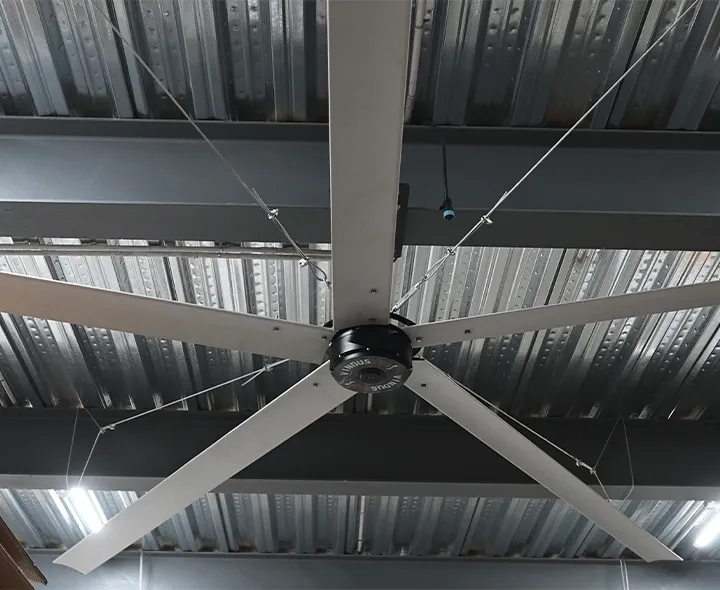
A fan that spins faster does not always cool a large building better. Choosing by RPM alone can leave hot zones, raise noise, and waste energy. The better approach is to match fan speed, diameter, airflow pattern, and coverage to the actual building and people inside it.
The main difference between high-speed and low-speed fans is how they move air. High-speed fans create concentrated, fast airflow over a smaller area. A large HVLS low-speed fan uses a much bigger diameter to move a high volume of air gently across a broad space. The right choice depends on coverage, ceiling height, occupancy, HVAC design, and whether you need spot cooling or whole-space circulation.

High-Speed vs Low-Speed Fans: How HVLS Fan Speed Affects Airflow, HVAC Performance, and Air Quality
Schema dell'articolo
- What Is the Real Difference Between High-Speed and Low-Speed Fans?
- Why Does Fan Speed Alone Not Tell You How Much Air a Fan Moves?
- How Do High-Speed Fans Work in Industrial and Commercial Spaces?
- How Does an HVLS Fan Move a Large Volume of Air at Low Speed?
- Which Fan Provides Better Air Circulation in Large Spaces?
- How Do Fan Speed and Airflow Affect Energy Efficiency and HVAC?
- Can Low-Speed Fans Improve Air Quality and Ventilation?
- How Do HVLS Fans Help With Heating and Cooling Throughout the Year?
- Where Should You Use High-Speed Fans and Where Should You Use HVLS?
- How Do You Choose the Right Fan Speed for Your Building?
1. What Is the Real Difference Between High-Speed and Low-Speed Fans?
The simplest difference is air velocity versus air volume.
A high-speed fan usually uses a smaller fan diameter and higher rotational speed. It pushes a concentrated stream of air toward a specific area. If you stand directly in front of one, the airflow can feel strong. Move farther away, though, and that effect may fall quickly.
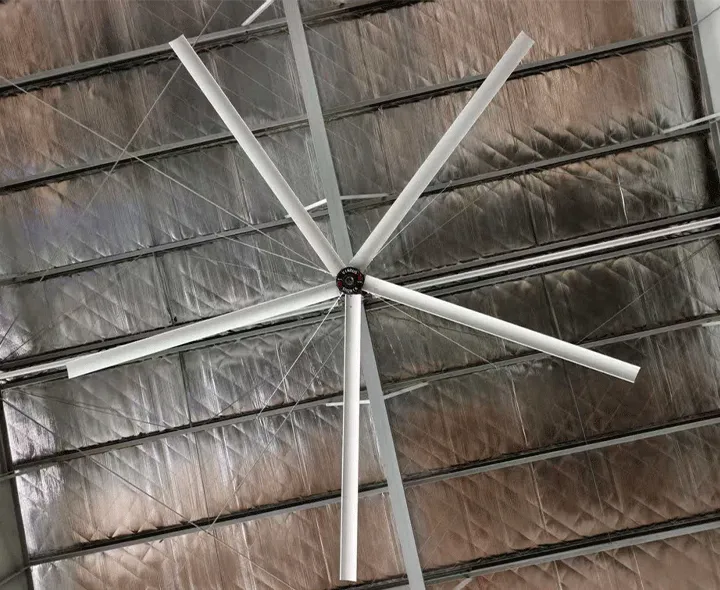
A low-speed fan used in an HVLS system works differently. Instead of relying on high RPM, it uses large fan blades and a wide diameter to move a much larger column of air. The airflow usually feels slower and softer, but it can spread across a much larger occupied area.
| Fattore |
Ventilatore ad alta velocità |
HVLS Low-Speed Fan |
| Diametro del ventilatore |
Usually smaller |
Grande |
| Rotational speed |
Più alto |
Inferiore |
| Air pattern |
Concentrated |
Ampio |
| Typical use |
Spot cooling |
Whole-area circulation |
| Rumore |
Often higher |
Usually lower |
| Copertura |
Local |
Ampio |
| Common installation |
Floor, wall, portable |
Ceiling |
| Il migliore per |
Workstation or machine area |
Warehouse or large hall |
This distinction matters because people sometimes assume that a higher fan speed always means more cooling. It does not.
ASHRAE recognizes air speed as one of several factors that affect thermal comfort, together with temperature, humidity, thermal radiation, clothing, and activity level.
For facility owners, that means the right question is not:
“Which fan spins faster?”
The better question is:
“Which fan creates the right air movement across the area where people actually work?”
2. Why Does Fan Speed Alone Not Tell You How Much Air a Fan Moves?
RPM is easy to understand, so buyers often use it as a quick comparison. But fan speed alone does not describe airflow performance.
Imagine two fans.
One fan has a small diameter and rotates very quickly. The second has blades several times longer but turns much more slowly. Even though the second fan has a lower fan speed, each revolution sweeps a far larger area.
That large rotating disc can move a large amount of air.
This is one of the main principles behind high-volume low-speed fans.
Four Variables Matter More Than RPM Alone
When comparing fans, consider:
- Diametro
- Blade profile
- Rotational speed
- Motor and control performance
Blade pitch, blade width, number of blades, clearance, and installation height also affect the final airflow pattern.
This is why comparing a residential fan running at several hundred RPM with a 20- or 24-feet HVLS ceiling fan by speed alone is not useful. They perform very different jobs.
AMCA Standard 230 establishes standardized laboratory methods for determining the airflow performance of air-circulating and ceiling fans. A serious product comparison should therefore focus on tested airflow and power performance, not just RPM.
At COOL, we use this same engineering mindset when reviewing large-space projects. The building comes first. Then we determine the appropriate diameter, speed range, location, and control strategy.
3. How Do High-Speed Fans Work in Industrial and Commercial Spaces?
High-speed fans are useful equipment. The mistake is assuming they are suitable for every application.
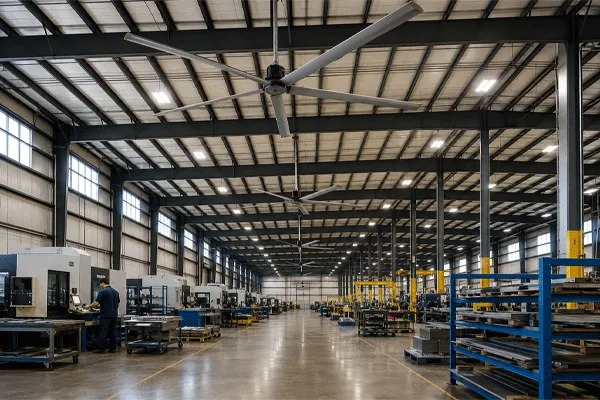
A smaller high-speed industrial fan creates strong air movement in a relatively focused direction. This makes it useful when workers need immediate airflow around a specific workstation, loading dock, production machine, or maintenance area.
Portable drum fans and wall-mounted fans are common examples.
Where High-Speed Fans Work Well
A high-speed fan may be suitable for:
- Individual production stations
- Welding or fabrication areas
- Loading docks
- Garage
- Temporary work zones
- Equipment cooling
- Maintenance areas
The direct breeze can create a strong cooling effect for people close to the unit.
However, small high-speed fans usually do not circulate air throughout a very large building as evenly as a properly sized HVLS ceiling fan.
One fan near a workstation may feel powerful while another part of the warehouse still has stagnant air.
Using many smaller fans can solve some local problems, but it also adds:
- Electrical connections
- Floor or wall space requirements
- Maintenance points
- Noise sources
- Additional controls
That does not mean small fans are bad. It means they solve a different problem.
In many industrial spaces, high-speed and low-speed fans can complement each other. HVLS fans handle broad circulation, while smaller units provide targeted airflow where necessary.
4. How Does an HVLS Fan Move a Large Volume of Air at Low Speed?
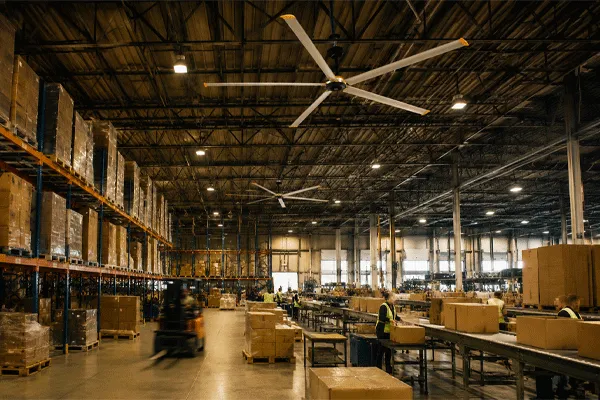
An HVLS fan uses its large diameter to create a wide moving column of air.
As the fan blades rotate, air moves downward toward the floor. It then spreads outward across the occupied zone before gradually moving upward again.
This creates broad circulation throughout the space.
The key is scale.
A large ceiling fan does not need to spin like a small residential fan because every rotation sweeps a much larger area.
Think of It This Way
A small fan is like spraying water from a narrow hose.
The flow may be fast, but it is concentrated.
An HVLS fan is more like moving a broad sheet of air across the building. The air at low speed can cover a far greater area without producing the same sharp blast.
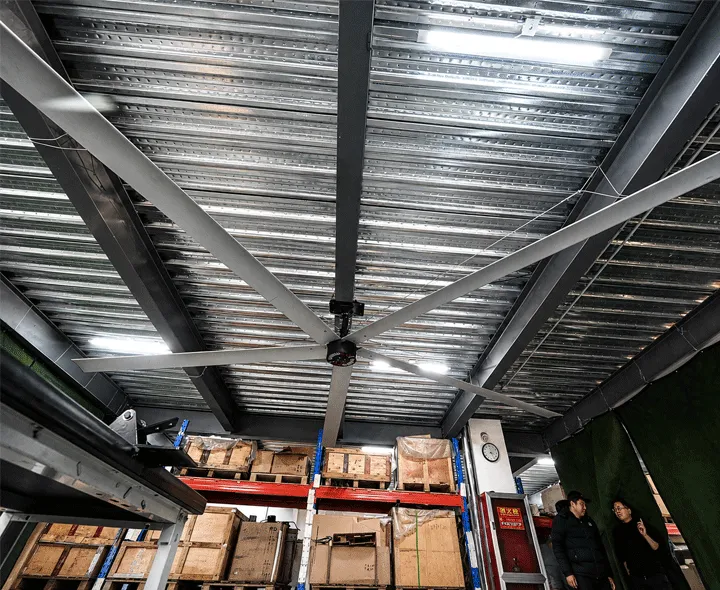
COOL offers several five-blade PMSM direct-drive product families for different building sizes.
The P680 covers 8–14 ft diameters. P730 models are available in 16 ft and 18 ft sizes, while P780 models are available in 20 ft and 24 ft configurations.
The important point is not simply that the fan is large. The fan, motor, blades, controller, installation height, and layout must work as one system.

High-Speed vs Low-Speed Fans: How HVLS Fan Speed Affects Airflow, HVAC Performance, and Air Quality
5. Which Fan Provides Better Air Circulation in Large Spaces?
If the objective is broad air circulation across a warehouse, production hall, logistics center, or sports facility, an HVLS fan generally has an important advantage: coverage.
A small fan can create higher local air velocity, but its influence is concentrated. A large HVLS fan moves air across a wider footprint.
Consider a warehouse containing:
- Tall pallet racks
- Loading areas
- Forklift routes
- Picking stations
- Packing areas
- Workers spread across a large floor
Installing a small high-speed fan at one end of the building will not automatically improve conditions everywhere.
A properly planned HVLS system can help reduce temperature and airflow differences across the occupied zone.
For warehouse applications, see COOL’ warehouse HVLS fan airflow solutions.
Airflow Is Also About Direction
Good air circulation does not simply mean “more air.”
The air needs to reach useful areas.
Fan placement should account for:
- Storage racks
- Walls and partitions
- Structural columns
- Cranes
- Production equipment
- Lighting
- Sprinklers
- Altezza del soffitto
This is why one single HVLS fan may perform very well in an open hall but less effectively if large obstructions interrupt the airflow path.
The same principle applies to manufacturing. COOL’ industrial manufacturing airflow solutions focus on large working areas where heat, machinery, and employee locations affect the fan layout.
6. How Do Fan Speed and Airflow Affect Energy Efficiency and HVAC?
Higher speed normally requires additional power, but comparing energy consumption only by fan speed is misleading.
A small fan may use relatively little electricity, but a facility may require many units to cover the same area that a larger HVLS system can serve.
The better question is:
How much useful airflow does the complete system provide for the electrical power consumed?
Example: One Large System vs Multiple Small Fans
Suppose a facility uses many small high-speed fans.
Each unit may seem inexpensive, but together they create:
- Multiple motors
- Multiple electrical circuits
- More maintenance points
- More individual controls
- More possible failure points
A single HVLS fan may cover a larger area with fewer pieces of equipment.
That does not automatically guarantee lower energy use in every building, but it changes the system-level calculation.
What About the HVAC System?
Air movement can support thermal comfort, allowing facility managers to operate heating and cooling equipment more strategically.
ASHRAE Standard 55 specifically treats air speed as a thermal comfort factor. Higher air speed can improve comfort under suitable warm conditions, but the actual effect depends on temperature, humidity, clothing, and activity.
This means operators may sometimes be able to adjust a thermostat while maintaining occupant comfort.
However, avoid universal claims.
A statement such as “a fan will always make the room feel 10 to 12 degrees cooler” is too broad. The real cooling effect varies with air velocity and building conditions.
At COOL, we recommend looking at the complete HVAC system, rather than treating the fan as an isolated product.
7. Can Low-Speed Fans Improve Air Quality and Ventilation?
This question needs a careful answer.
HVLS fans can improve air circulation, but they do not automatically improve indoor air quality.
A fan moves existing indoor air. It does not create oxygen, remove pollutants, or replace indoor air with fresh air from the outside.
If a building contains:
- Welding fumes
- Dust
- Chemical vapors
- High carbon dioxide levels
- Process emissions
- Excess moisture
the facility may require mechanical exhaust, filtration, make-up air, outdoor-air ventilation, or source capture systems.
A fan can help circulate air throughout a space, but it should not be used as a substitute for required ventilation.
Air Circulation vs Ventilation
| Funzione |
Ventilatore HVLS |
Mechanical Ventilation |
| Moves indoor air |
Sì |
Sì |
| Creates broad circulation |
Sì |
Depends on design |
| Brings in outdoor fresh air |
No |
Yes, when designed to |
| Removes contaminants |
No |
Potere |
| Exhausts process air |
No |
Sì |
| Improves thermal comfort |
Sì |
Potere |
| Controls pollutant concentration |
Not by itself |
Sì |
This distinction is especially important in food processing, manufacturing, agriculture, and other industrial environments.
If air quality is a concern, the correct solution may combine ventilation and air circulation.
ASHRAE treats indoor air quality and thermal comfort as separate design issues. Standard 55 addresses thermal conditions including air speed, while the 62-series standards address ventilation and acceptable indoor air quality.
So when a supplier says that a ceiling fan alone will “improve air quality,” ask what they actually mean.
It may improve the distribution of indoor air. It does not replace contaminant control.
8. How Do HVLS Fans Help With Heating and Cooling Throughout the Year?
Many people think of fans only as summer equipment.
That misses half the story.
Summer: Produce a Cooling Effect
When air moves across the skin, evaporation and convective heat transfer increase. People can feel more comfortable even though the fan has not actually reduced the temperature of the air.
An HVLS ceiling fan can create this cooling effect across a broad occupied area.
Winter: Reduce Thermal Stratification
Hot air naturally rises.
In a building with high ceilings, warm air from the heating system may become trapped at the ceiling while employees near the floor remain cold.
This temperature layering is called thermal stratification.
A low fan speed or appropriate reverse operating strategy can help redistribute warm air toward the floor without producing an uncomfortable draft.
This can help:
- Reduce temperature differences
- Support heating system performance
- Limit heat loss near the roof
- Improve comfort at worker level
The exact operating strategy depends on the fan, building, and heating system.
This is one reason variable speed options matter. A fan that works well during summer cooling may need a much lower speed during winter.
Smart controls can make this easier. COOL’ FanBrain intelligent HVLS control system is designed to support automation, scheduling, speed control, and temperature-based operation.

High-Speed vs Low-Speed Fans: How HVLS Fan Speed Affects Airflow, HVAC Performance, and Air Quality
9. Where Should You Use High-Speed Fans and Where Should You Use HVLS?
Neither fan type wins every comparison.
The right fan depends on the job.
Application Decision Table
| Applicazione |
Ventilatore ad alta velocità |
Ventilatore HVLS |
| Individual workstation |
Eccellente |
Limited benefit |
| Small garage |
Buono |
Usually unnecessary |
| Large warehouse |
Supplemental |
Eccellente |
| Distribution center |
Supplemental |
Eccellente |
| Large manufacturing floor |
Good for local zones |
Excellent for broad circulation |
| Sports hall |
Limitato |
Eccellente |
| Commercial hall |
Sometimes |
Buono |
| Loading dock |
Buono |
Depends on layout |
| High-humidity process area |
Useful locally |
Useful for circulation |
| High-ceiling heated building |
Limitato |
Strong destratification potential |
Use High-Speed Fans When:
- You need strong airflow in one specific location.
- Workers stay close to the fan.
- Installation must be portable.
- The building is small.
- Equipment or process areas require targeted air movement.
Consider HVLS When:
- The area is large and open.
- Workers are spread throughout the building.
- The ceiling is high enough for safe installation.
- You need broad, gentle circulation.
- You want to coordinate fans with heating and cooling systems.
- Noise and drafts are concerns.
Many facilities use both.
For example, an HVLS fan may circulate air across a production hall, while small high-speed fans serve hot machinery areas.
This hybrid design often makes more sense than forcing one type of fan to solve every airflow problem.
10. How Do You Choose the Right Fan Speed for Your Building?
Choosing the right fan is not primarily about choosing a high fan speed or a lower speed.
Start with the building.
We recommend collecting the following project information:
- Building length and width
- Altezza del soffitto
- Lowest obstruction height
- Worker locations
- Storage rack layout
- Heat-producing equipment
- Existing HVAC equipment
- Exhaust and fresh-air systems
- Typical temperature and humidity
- Daily operating schedule
Then define the goal.
Are you trying to:
- Cool workers?
- Improve air circulation?
- Reduce stagnant air?
- Support the HVAC system?
- Redistribute warm air?
- Reduce heating costs?
- Improve comfort in a high-humidity building?
Once the goal is clear, engineers can evaluate diameter, airflow, placement, and speed setting.
Do Not Automatically Choose the Highest Speed Setting
A higher fan speed can produce more local air velocity, but that does not mean it should always be used.
Too much air movement may:
- Disturb papers or packaging
- Affect lightweight products
- Cause uncomfortable drafts
- Create unnecessary noise
- Increase energy use
Modern controls allow facility managers to adjust the fan speed based on operating conditions.
An auto fan speed strategy can also use temperature inputs or schedules so the fan does not run at maximum output when it is unnecessary.
At COOL, we approach projects as airflow systems rather than single pieces of equipment. Our goal is to match the fan, controller, mounting location, and operating strategy to the building.
For larger facilities, the complete industrial HVLS fan system and installation approach should be reviewed before equipment is ordered.
High-Speed vs Low-Speed Fans: Quick Comparison Chart
| Domanda |
High-Speed |
Low-Speed HVLS |
| Which spins faster? |
Ventilatore ad alta velocità |
HVLS is slower |
| Which provides stronger local airflow? |
Ad alta velocità |
Usually not the objective |
| Which moves air over a larger area? |
Limitato |
Alto livello di voltura |
| Which suits high ceilings? |
Sometimes |
Often |
| Which is better for one workstation? |
Ad alta velocità |
Usually unnecessary |
| Which suits large open buildings? |
Supplemental |
Alto livello di voltura |
| Which can support destratification? |
Limitato |
Sì |
| Which is usually quieter? |
Depends on model |
Often HVLS |
| Does either provide fresh air? |
No |
No |
| Can either replace HVAC? |
No |
No |
Domande frequenti
Does a high-speed fan always move more air than a low-speed fan?
No. Fan speed is only one factor. Diameter, blade shape, blade pitch, and motor performance also matter. A large HVLS fan can move large volumes of air at low rotational speed because its blades sweep a much greater area.
Why do HVLS fans spin so slowly?
HVLS fans spin slowly because their large diameter allows them to move a broad column of air without requiring the high rotational speed of a smaller fan. The objective is wide coverage and gentle circulation rather than a narrow high-velocity jet.
Can one HVLS fan replace several smaller fans?
In some large open buildings, a single HVLS unit can provide broader coverage than several smaller fans. However, the correct number depends on floor area, fan diameter, ceiling height, obstructions, and desired airflow.
Can an HVLS fan lower the actual room temperature?
A fan usually does not lower the dry-bulb air temperature by itself. It creates air movement that can produce a cooling effect on people. During winter, it can also help redistribute warm air trapped at the ceiling.
Do HVLS fans improve indoor air quality?
They can improve air circulation, but they do not automatically improve indoor air quality. They do not replace filtration, exhaust, source capture, or outdoor-air ventilation where those systems are required.
Is a lower fan speed always more energy-efficient?
Not automatically. Lower speed generally reduces fan power demand, but system efficiency should be evaluated using actual airflow, power consumption, coverage, and operating hours. A low-speed fan that does not meet the airflow requirement is not an efficient solution for that application.
Key Things to Remember
- High speed does not automatically mean higher total airflow.
- Small high-speed fans are best for concentrated spot cooling.
- HVLS fans use large diameter and low speed to move a large volume of air across wide areas.
- Fan speed, diameter, blade design, and installation height must be evaluated together.
- Air movement can improve thermal comfort, but a fan does not actually refrigerate the air.
- HVLS fans can support HVAC operation and winter destratification.
- A ceiling fan cannot replace fresh-air ventilation, filtration, or exhaust equipment.
- Use tested airflow and power data instead of comparing RPM alone.
- High-speed and HVLS fans can work together in the same industrial facility.
- The right fan depends on your building, occupancy, heat load, ceiling height, and airflow objective.
For warehouse owners, factory managers, HVAC contractors, logistics operators, and industrial distributors, the best fan is not necessarily the fastest one. It is the fan that moves air where you need it, at the right speed, with the right coverage and control strategy.
If you are planning an industrial or commercial airflow project, share your building dimensions, ceiling height, operating conditions, and layout with COOL Fans. Our engineering team can help evaluate the appropriate HVLS fan size, placement, and control strategy for your facility.