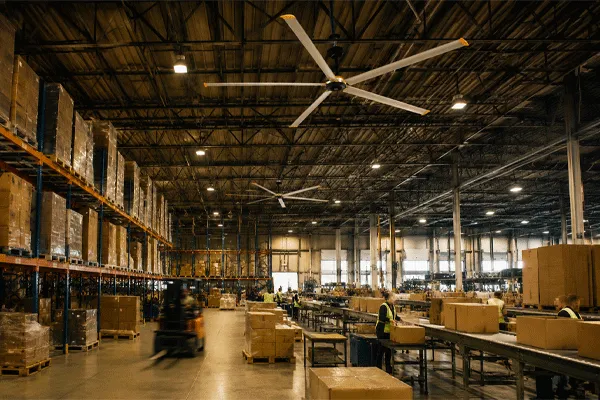
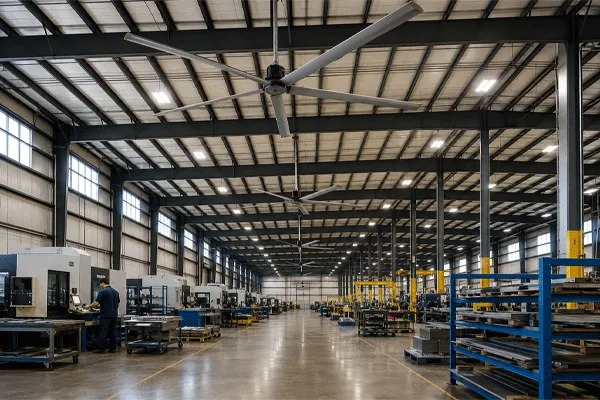
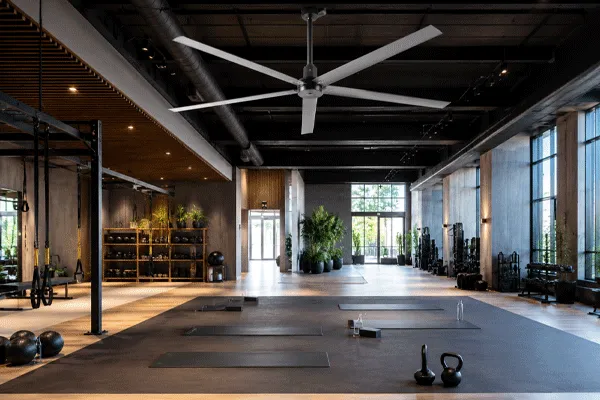
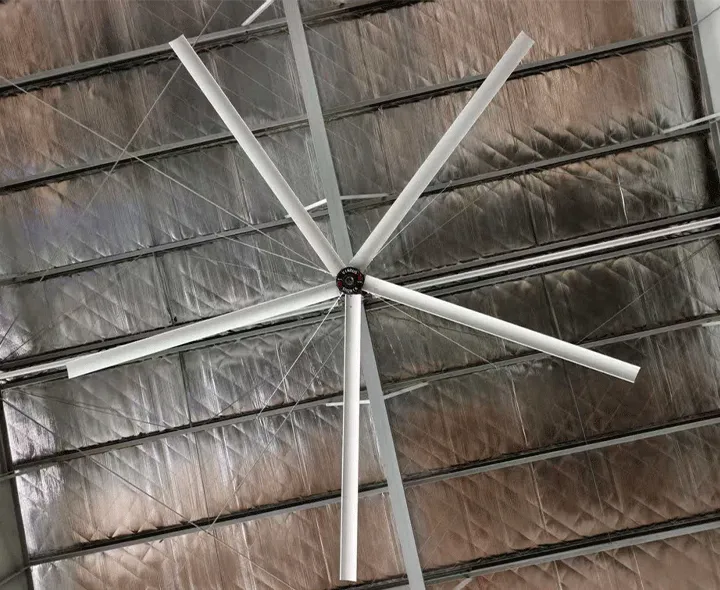
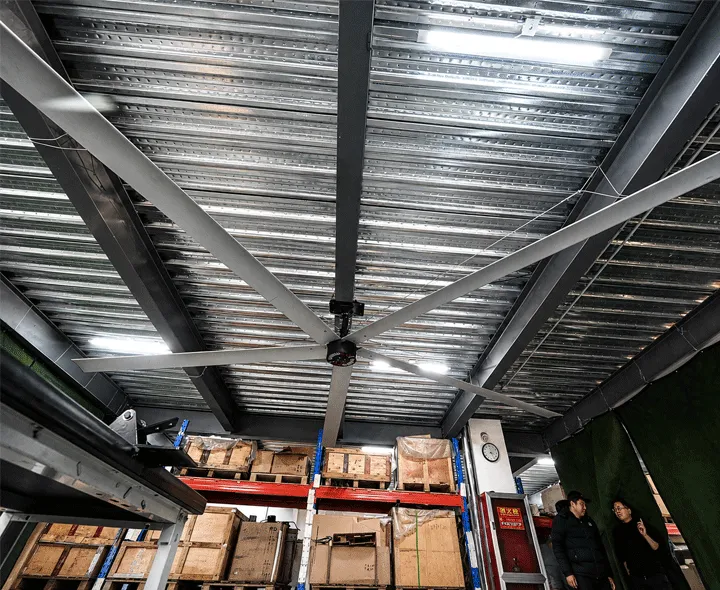
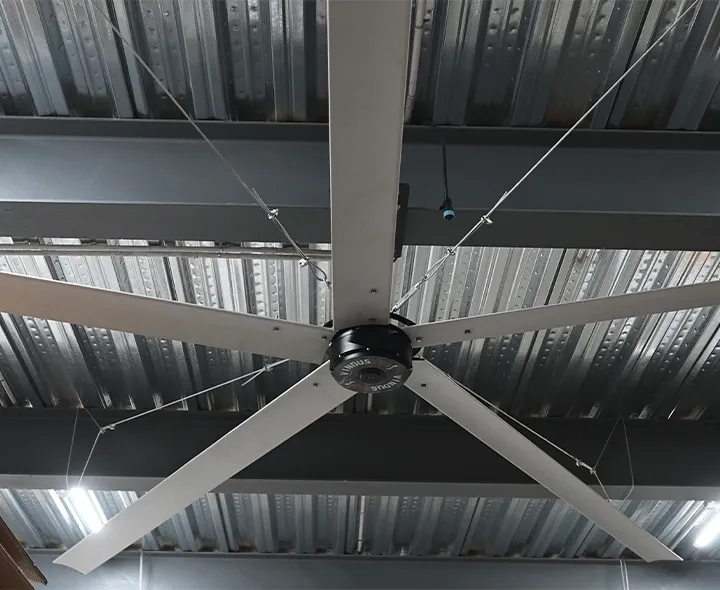
Large commercial buildings and agricultural facilities can both suffer from trapped heat and poor airflow, but they do not need the same fan strategy. Choose only by fan diameter or price, and you may create weak coverage, excess energy use, or poor environmental control.
An HVLS fan cools commercial and agricultural spaces by moving a high volume of air at low speed across a wide area. In commercial buildings, the main goals are usually human comfort and HVAC support. In agricultural settings, airflow planning must also consider humidity, crops, livestock, ventilation, and seasonal environmental conditions.

HVLS Ceiling Fans for Commercial and Agricultural Spaces: Cooling, Airflow, and Hunter Industrial Comparison
Esquema del artículo
- Why Do Commercial and Agricultural Spaces Need Different HVLS Fan Strategies?
- How Does an HVLS Ceiling Fan Cool a Large Space?
- What Matters Most When Cooling Large Commercial Spaces?
- How Is HVLS Airflow Different in Agricultural Settings?
- How Do Ceiling Height, Fan Diameter, and Layout Affect Performance?
- How Can Industrial HVLS Fans Improve Energy Efficiency?
- How Do HVLS Fans Support Heating and Cooling Year-Round?
- Why Do Direct Drive Motors and Smart Controls Matter?
- How Does COOL Compare With Hunter Industrial HVLS Fans?
- How Do You Choose the Best HVLS Fan for Your Space?
1. Why Do Commercial and Agricultural Spaces Need Different HVLS Fan Strategies?
A shopping center and a greenhouse can both be large open spaces. They may even have similar ceiling heights. But their airflow goals are very different.
In a large commercial building, the main concern is often people. Facility managers want customers, staff, or visitors to feel comfortable without forcing the HVAC system to carry the full cooling load. Noise, appearance, drafts, and year-round operation also matter.
Agricultural settings add another layer.
A greenhouse may need air circulation to limit stagnant humid zones and help keep temperatures more uniform around plants. A barn may need air movement around animals while still relying on a separate ventilation system for fresh-air exchange.
That difference is important.
An HVLS fan circulates indoor air. It does not automatically replace exhaust fans, outside-air ventilation, evaporative cooling, or other environmental control equipment.
University extension guidance for greenhouse production also separates air circulation from ventilation. Good air circulation helps reduce local humidity and temperature differences, while exhaust and vent systems handle air exchange.
For this reason, we do not start an airflow project by asking, “How many big fans do you want?”
We start with:
- What is happening inside the building?
- Who or what occupies the space?
- Where does heat come from?
- Where does moisture come from?
- Is HVAC already installed?
- Does the building require outdoor-air exchange?
- What ceiling height and mounting positions are available?
That is the difference between buying a ceiling fan and designing an airflow system.
COOL separates these needs through dedicated commercial HVLS fan solutions y agricultural HVLS fan solutions.
2. How Does an HVLS Ceiling Fan Cool a Large Space?
HVLS means High Volume Low Speed.
An HVLS ceiling fan uses long fan blades and a large diameter to move a broad column of air at relatively low rotational speed.
The fan pushes air downward. When that airflow reaches the occupied zone and floor, it spreads outward across the space before gradually returning upward.
The result is broad air movement instead of a narrow, high-speed jet.
Why Low Speed Works
A smaller fan must rotate faster because its blades sweep a smaller area.
A large HVLS ceiling fan works differently. Each rotation moves air across a much larger disc area, allowing the fan to move massive volumes of air without relying on the speed of smaller high-speed fans.
That gives HVLS technology three important characteristics:
- Broad coverage
- Lower local air velocity
- Relatively quiet operation
The cooling effect on people comes mainly from increased heat transfer and evaporation at the skin.
ASHRAE Standard 55 identifies air speed as one of the environmental factors that influence human thermal comfort, together with air temperature, humidity, and thermal radiation.
This is especially useful in large commercial spaces because operators may be able to improve perceived cooling without lowering the actual air temperature as aggressively.
However, a fan is not an air conditioner.
It moves air. It does not generate refrigeration.
3. What Matters Most When Cooling Large Commercial Spaces?
Commercial spaces often have a simple goal on paper:
Keep people comfortable while controlling energy costs.
In practice, that can be difficult.
Large retail stores, shopping centers, exhibition halls, fitness facilities, vehicle showrooms, terminals, and public buildings may contain:
- Tall ceilings
- Large glazed walls
- Open floor plans
- Changing occupancy
- Heat from lighting
- Solar gain
- Uneven HVAC supply
- Entrance doors that open frequently
A traditional ceiling fan may serve a small room well, but it usually cannot create uniform airflow across a large commercial floor plate.
An HVLS fan is designed for these wider coverage requirements.
Commercial Design Priorities
| Requirement |
Por qué es importante |
| Quiet operation |
Customers and staff should not be distracted |
| Wide airflow |
Reduces hot and stagnant zones |
| Ceiling clearance |
Determines safe fan diameter |
| HVAC coordination |
Helps distribute conditioned air |
| Appearance |
Important in public-facing buildings |
| Variable speed |
Allows adjustment for occupancy |
| Reverse operation |
Supports winter destratification |
| Controla |
Simplifies multi-fan operation |
COOL has a published commercial-building project in Spain where the site reported using HVLS fans with its heating system for winter destratification and reported a 38% reduction in energy bills. That is a single project result, not a universal savings guarantee.
The important lesson is not the percentage.
It is the system approach.
The fan and HVAC system were operating together.
For medium-size retail, hospitality, workshop, or commercial areas, the P680 Series HVLS fan covers diameters from 8 to 14 ft and recommended blade heights from 10 to 25 ft. Current published maximum power ranges from 100 to 290 W depending on model.
4. How Is HVLS Airflow Different in Agricultural Settings?
Agricultural buildings create airflow problems that commercial buildings may never experience.
Plants release moisture. Animals generate heat and humidity. Irrigation raises moisture levels. Bedding, manure, stored crops, soil, and wash-down water can all change the indoor environment.
A greenhouse therefore needs more than perceived cooling.
Good air circulation helps mix air around the crop canopy and reduce local temperature and humidity differences.
Penn State notes that good air circulation can reduce relative humidity around plants and help limit conditions favorable to gray mold. UMass Extension likewise recommends combining air circulation with ventilation when managing greenhouse humidity.
Greenhouse Example
Imagine a greenhouse on a sunny afternoon.
Warm air rises toward the ceiling. Moisture from plants and soil enters the air. At night, surfaces cool and condensation may form.
A well-planned airflow system can help mix the indoor air mass and reduce stagnant zones.
But an HVLS ceiling fan cannot remove moisture from the greenhouse by itself.
The building may still need:
- Roof vents
- Sidewall openings
- Ventiladores de extracción
- Intake louvers
- Heating
- Dehumidification
- Enfriamiento evaporativo
Oklahoma State University specifically treats circulating fans and exhaust ventilation as different parts of greenhouse environmental control.
The same principle applies to a livestock barn.
Broad HVLS air circulation can complement high-speed or exhaust equipment, but it should not be treated as a substitute for fresh-air exchange.
For broader crop and farm applications, COOL provides dedicated agriculture airflow applications.

HVLS Ceiling Fans for Commercial and Agricultural Spaces: Cooling, Airflow, and Hunter Industrial Comparison
5. How Do Ceiling Height, Fan Diameter, and Layout Affect Performance?
Buying the biggest fan available is not a professional design strategy.
The right HVLS fan depends on the relationship between:
fan diameter + ceiling height + spacing + obstructions + occupied zone.
A 24 ft fan may work very well in a large warehouse or tall agricultural building. The same fan may be inappropriate in a lower commercial building with lighting, sprinkler pipes, decorative ceilings, or structural obstructions.
COOL P-Series Selection Reference
| Series |
Diámetro |
Recommended Blade Height |
Typical Use |
| P680 |
8–14 ft |
10–25 ft |
Medium commercial and industrial spaces |
| P730 |
16–18 ft |
20–33 ft |
Larger commercial and industrial buildings |
| P780 |
20–24 pies |
20–33 ft |
Large open high-ceiling spaces |
COOL currently publishes P730 as a PMSM-driven 16–18 ft series intended for large commercial and industrial spaces, while P780 covers 20 ft and 24 ft configurations.
El P730 Series HVLS fan can therefore suit facilities that need more coverage than P680 but do not require a 20- or 24-ft large ceiling fan.
For very large open spaces, the P780 Series HVLS fan provides the largest P-Series diameter range.
What Changes the Layout?
Fan placement should consider:
- Structural beams
- Racking
- Greenhouse crop rows
- Lighting
- Irrigation equipment
- Sprinklers
- Cranes
- HVAC ducts
- Ventiladores de extracción
- Walls and partitions
- Animal zones
- Customer seating or retail fixtures
Two buildings with the same number of square feet may therefore need completely different fan systems.
6. How Can Industrial HVLS Fans Improve Energy Efficiency?
Energy efficiency is not simply a question of finding the fan with the lowest wattage.
A better question is:
How much useful airflow does the complete fan system provide for the electrical energy it consumes?
One low-power fan that cannot reach the occupied area is not an efficient solution.
Neither is installing eight smaller fans when one correctly selected HVLS fan could provide the required coverage.
Evaluate System-Level Energy Use
For every proposed system, compare:
- Number of fans
- Rated power
- Expected operating speed
- Daily operating hours
- Coverage area
- HVAC interaction
- Seasonal operation
- Maintenance requirements
A simple annual estimate is:
Annual Energy Consumption = Fan Power × Operating Hours
But this alone does not tell you whether the fan is effective.
For large commercial buildings, you should also measure how the fan affects HVAC runtime and thermostat strategy.
For agricultural settings, compare energy consumption against the airflow delivered to plant, animal, or work zones.
Why Performance Testing Matters
Do not compare industrial HVLS fans only by RPM or motor wattage.
ANSI/AMCA Standard 230 establishes uniform laboratory methods for testing air-circulating and ceiling fans in terms of airflow performance.
A professional B2B buyer should therefore ask for:
- Airflow data
- Input power
- Test method
- Operating speed
- Sound level
- Installation conditions
That gives you a much better picture of energy efficiency than marketing phrases such as “energy-efficient fans.”
7. How Do HVLS Fans Support Heating and Cooling Year-Round?
HVLS fans are often purchased for summer cooling, but large ceiling systems can also support winter operation.
During summer, downward airflow creates perceived cooling for people and improves broad air movement.
During winter, the problem changes.
Warm air naturally rises.
In buildings with high ceilings, heat can collect near the roof while the occupied zone remains cooler.
A low-speed reverse or destratification strategy can help remix these temperature layers.
This can be useful in:
- Almacenes
- Showrooms
- Commercial halls
- Talleres
- Heated agricultural buildings
The objective is not to create a strong winter breeze.
The objective is to reduce the temperature difference between upper and lower parts of the building.
Commercial vs Agricultural Winter Operation
Commercial buildings usually focus on occupant comfort and heating costs.
Agricultural buildings may also need to consider:
- Crop temperature
- Condensation
- Animal comfort
- Humidity
- Required outdoor-air ventilation
This means the same winter speed setting should not automatically be applied to both buildings.
A greenhouse, for example, may require continuous circulation but also controlled fresh-air exchange to manage humidity.
A retail building may focus more heavily on moving warm ceiling air toward customers and staff.
That is why variable-speed and reversible control can be valuable for year-round operation.
8. Why Do Direct Drive Motors and Smart Controls Matter?
A modern HVLS industrial system is not just a set of fan blades.
The motor and controller have a major influence on operation, maintenance, and airflow flexibility.
COOL P-Series products use PMSM direct drive technology.
Direct drive removes the traditional belt or gearbox transmission between the motor and the fan hub.
Potential system advantages include:
- Fewer transmission components
- No traditional gearbox oil changes
- Variable-speed operation
- Low-speed torque
- Reduced mechanical complexity
P730 and P780 are positioned as PMSM direct-drive large-space products with published maximum power below 1,000 W.
Why Smart Control Matters More in Mixed Facilities
Consider a large agricultural operation with:
- Greenhouses
- Packing area
- Depósito
- Maintenance shop
Or a large commercial development with:
- Retail zone
- Loading area
- Atrium
- Service area
Those zones should not always operate at the same fan speed.
El FanBrain intelligent HVLS control system is designed around automation, centralized operation, and energy-efficient fan management.
Smart controls allow a facility to respond to actual operating conditions instead of running every fan at maximum output all day.
That is where real energy savings often begin: not just with an efficient motor, but with better operating decisions.
9. How Does COOL Compare With Hunter Industrial HVLS Fans?
Hunter Industrial is one of the established names buyers may research when evaluating the best HVLS fans for commercial or agricultural projects.
Its 2026 product catalog lists several industrial HVLS lines:
| Hunter Industrial Series |
Rango de diámetro |
Positioning |
| XP |
7–14 ft |
Compact HVLS |
| ECO |
8–24 pies |
Broad-range economical option |
| Titan |
14–24 ft |
Premium large industrial fan |
| DDI |
20–24 pies |
Large direct-drive solution |
Hunter’s Titan, ECO, and XP models are listed in the AMCA Certified Ratings Program, with the 7 ft XP excluded.
COOL uses a different product structure:
| COOL Series |
Diámetro |
Blade Configuration |
Drive |
| P680 |
8–14 ft |
5 blades |
PMSM direct drive |
| P730 |
16–18 ft |
5 blades |
PMSM direct drive |
| P780 |
20–24 pies |
5 blades |
PMSM direct drive |
What Should Buyers Actually Compare?
Do not choose Hunter Industrial, COOL, or any other supplier simply because one has the largest fan.
Compare:
- Tested airflow
- Diámetro del ventilador
- Ceiling height requirements
- Motor technology
- Input power
- Dise?o de la hoja
- Controla
- Ruido
- Certificaciones
- Environmental protection
- Garantía
- Engineering support
- Spare parts
- Installation support
Hunter Industrial’s Titan, for example, uses five structural-grade aluminum blades and direct drive technology, while its ECO uses four blades.
COOL uses five blades throughout the P-Series.
Blade count alone does not determine which fan generates better airflow.
Always compare complete fan performance.

HVLS Ceiling Fans for Commercial and Agricultural Spaces: Cooling, Airflow, and Hunter Industrial Comparison
10. How Do You Choose the Best HVLS Fan for Your Space?
The best HVLS fan is not a universal product.
It is the fan that fits the building and solves the actual airflow problem.
Start by identifying the space type.
For Commercial Buildings
Prioritize:
- Confort térmico
- Quiet operation
- HVAC coordination
- Aesthetics
- Occupancy changes
- Ceiling clearance
- Year-round controls
For Agricultural Buildings
Prioritize:
- Humidity
- Plant or animal zones
- Ventilation requirements
- Air circulation around crops
- Environmental protection
- Wash-down or dusty conditions
- Seasonal airflow
- Compatibility with exhaust equipment
For Warehouses and Industrial Environments
Prioritize:
- Racking
- Worker zones
- Loading doors
- Heat-producing equipment
- Altura del techo
- Broad coverage
COOL also provides dedicated warehouse HVLS fan solutions for large logistics and storage buildings.
Project Information to Prepare
Before asking for a quotation, collect:
- Building length and width
- Altura del techo
- Lowest obstruction height
- Existing HVAC
- Existing ventilation
- Floor plan
- Working zones
- Crop or animal zones
- Temperature and humidity
- Electrical supply
- Operating hours
This information lets an engineer choose the right HVLS fan instead of making a guess from square feet alone.
As a Sino-US joint venture manufacturer and airflow solution provider, we work with warehouse owners, commercial developers, HVAC contractors, agricultural operations, manufacturing facilities, equipment distributors, and global B2B buyers.
Our role is not simply to sell big fans.
Our role is to match fan diameter, mounting, airflow, controls, and operating strategy to the actual building.
If you are planning a new commercial or agricultural project, send us your floor plan, ceiling height, environmental conditions, and airflow goals. We can help evaluate whether P680, P730, P780, or another airflow solution is the right fit.
Preguntas frecuentes
Can one HVLS fan cool both a commercial building and a greenhouse?
Possibly, but the layout and operating strategy may be different. Commercial buildings mainly focus on occupant comfort and HVAC support, while greenhouses also need humidity management, crop-level circulation, and adequate ventilation.
Does an HVLS ceiling fan replace air conditioning?
No. An HVLS fan creates airflow and perceived cooling but does not refrigerate the air. It can complement HVAC by helping distribute conditioned air more evenly.
Can HVLS fans replace greenhouse exhaust fans?
No. HVLS fans circulate indoor air. Exhaust fans and natural vents are used to exchange indoor air with outside air. Many agricultural buildings benefit from using both systems.
What ceiling height is needed for an HVLS fan?
It depends on the model. COOL P680 is published for blade heights from 10–25 ft, while P730 and P780 are designed for recommended blade heights from 20–33 ft. Final installation also depends on obstructions and local requirements.
Are direct drive HVLS fans better than traditional drive systems?
Direct drive reduces mechanical transmission components and removes the need for a traditional gearbox. However, buyers should still compare complete airflow, power, controls, reliability, and service requirements.
How do I compare Hunter Industrial and COOL HVLS fans?
Compare equivalent diameters and request tested airflow, input power, certification information, motor specifications, controls, warranty terms, mounting requirements, and engineering support. Brand name alone does not determine the right fan.
Key Things to Remember
- Commercial and agricultural spaces should not use the same airflow design automatically.
- HVLS fans move high volumes of air at low speed across large areas.
- Commercial buildings focus heavily on human comfort, HVAC support, and quiet operation.
- Agricultural facilities must also consider humidity, ventilation, crops, animals, and environmental conditions.
- An HVLS fan circulates air but does not replace fresh-air ventilation or exhaust equipment.
- Ceiling height, fan diameter, obstructions, and layout determine useful airflow.
- Energy efficiency should be measured at system level, not by fan wattage alone.
- Direct drive and variable-speed controls improve operational flexibility.
- Year-round operation can support summer cooling and winter destratification.
- Hunter Industrial and COOL offer overlapping HVLS diameter ranges but different product configurations.
- Use verified airflow and power data when comparing industrial ceiling fans.
- The best HVLS fan is the one matched to the actual building and operating conditions.
Planning a commercial building, greenhouse, agricultural facility, warehouse, or other large open space?
Share your building dimensions, ceiling height, current HVAC or ventilation system, and airflow requirements with COOL Fans. Our engineering team can help you evaluate a suitable HVLS ceiling fan and control strategy for your project.