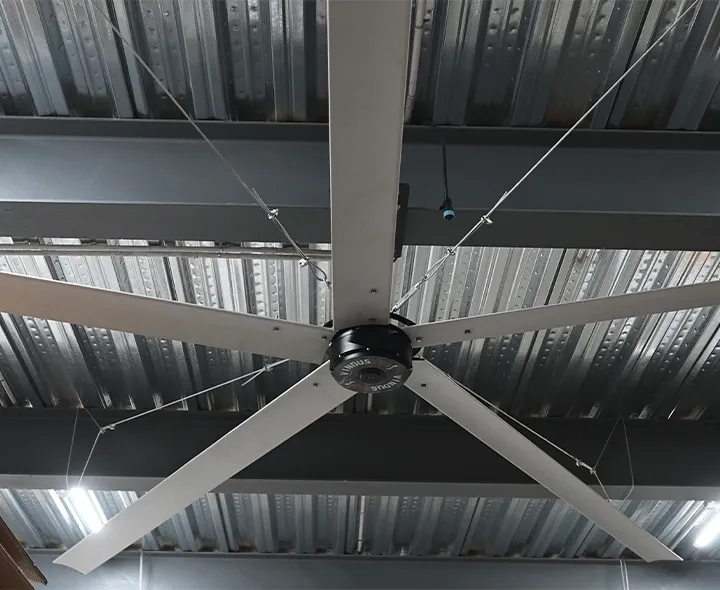
Choosing the wrong warehouse fan can lead to poor airflow, unnecessary energy costs, and expensive installation changes. A fan that works well in one building may fail in another. The key is to match fan diameter, ceiling height, motor design, and control features to the actual warehouse environment.
HVLS fans for warehouses are large-diameter, low-speed industrial ceiling fans designed to move air across extensive floor areas. The right model depends on building height, floor layout, operating conditions, and required airflow. COOL P680, P730, and P780 series provide different diameter and installation options for medium and large warehouse projects.

HVLS Fans for Warehouses: Compare P680, P730, and P780 Industrial Ceiling Fans
1. Why Should Warehouse Owners Choose an HVLS Fan System?
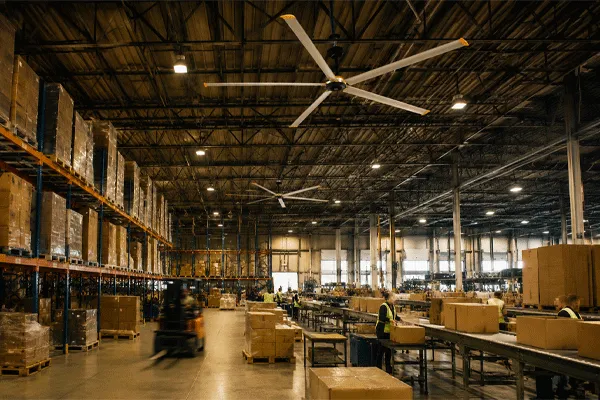
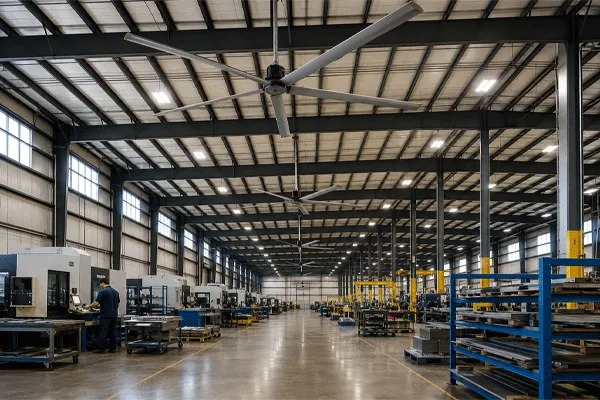
A warehouse is not an ordinary indoor space. High ceilings, pallet racks, forklifts, loading doors, and large open areas make it difficult to maintain even air movement. Traditional ceiling fans often provide airflow only within a limited area, while portable industrial fans can occupy valuable floor space.
An HVLS fan uses a large blade diameter and relatively low rotational speed to move a high volume of air. Air moves downward from the fan, spreads across the floor, and creates a broad circulation pattern. This helps reduce stagnant areas and improve comfort for employees working in storage, picking, packing, and distribution zones.
For warehouse owners, the benefits include:
-
Better airflow distribution: Improve air movement across large working areas.
-
Employee comfort: Create a more comfortable environment during hot working conditions.
-
HVAC support: Help distribute conditioned air more evenly.
-
Winter destratification: Redistribute warm air trapped near the ceiling.
-
Lower operating energy: Use fewer appropriately sized fans instead of relying entirely on multiple smaller units.
-
Flexible operation: Adjust fan speed to match occupancy and seasonal requirements.
However, an HVLS fan does not replace mechanical ventilation, exhaust systems, or air conditioning. It is an air circulation solution that works alongside these systems.
For different warehouse configurations, our warehouse HVLS fan solutions provide a starting point for understanding suitable applications.
2. How Do P680, P730, and P780 HVLS Fan Models Compare?
One of the most important purchasing decisions is selecting the correct model.
Not every warehouse needs the largest industrial fan available. A medium-sized logistics facility may benefit from a compact model, while a large distribution center with high ceilings may require a larger industrial ceiling fan.
COOL offers three relevant P-series product families with different diameters, recommended installation heights, and typical spacing.
COOL P-Series product comparison
| Specification |
P680 Series |
P730 Series |
P780 Series |
| Diámetro del ventilador |
8–14 ft |
16–18 ft |
20–24 pies |
| Recommended blade height |
10–25 ft |
20–33 ft |
20–33 ft |
| Número de cuchillas |
5 |
5 |
5 |
| Maximum power range |
100–290 W |
450–460 W |
560–950 W |
| Typical spacing range |
20–70 ft |
50–90 ft |
60–120 ft |
| Motor technology |
PMSM direct drive |
PMSM direct drive |
PMSM direct drive |
| Typical application |
Medium spaces |
Grandes espacios |
Large industrial spaces |
P680 Series: For medium-size warehouse areas
The P680 is designed for medium-size commercial and industrial spaces. Its 8–14 ft diameter options make it suitable for selected smaller warehouse zones, logistics areas, and workshops where a larger fan may not fit.
The series supports blade heights from 10 to 25 ft. Its five anodized aluminum blades, direct-drive design, and adjustable speed provide a compact solution for daily operation.
P730 Series: For medium-to-large warehouse buildings
The P730 offers 16 ft and 18 ft diameter options. It is designed for larger industrial and commercial environments with recommended blade heights of 20–33 ft.
Its direct-drive PMSM motor, floor-level integrated HMI, and single ceiling-to-floor cable simplify operation and maintenance planning.
P780 Series: For large industrial warehouses
The P780 is designed for large industrial and commercial spaces. Its 20 ft and 24 ft diameter options are suitable for warehouse projects requiring broad-area air movement.
The P780 uses a permanent magnet synchronous motor and consumes less than 1,000 W at maximum speed. Its floor-level integrated HMI also allows convenient operation and inspection without routine roof access to the control interface.
3. Which Industrial Ceiling Fan Is Suitable for Different Warehouse Heights?
Ceiling height is one of the first measurements buyers should provide when selecting an industrial ceiling fan.
A fan that is too small may not provide useful air movement across the occupied area. A fan that is too large may not have sufficient clearance for safe installation or effective operation.
Here is a preliminary model-selection reference:
| Warehouse conditions |
Model to evaluate |
Main consideration |
| 10–15 ft blade height |
P680 |
Compact installation |
| 15–25 ft blade height |
P680 |
Medium-size airflow zones |
| 20–25 ft blade height |
P730 / P780 |
Available mounting clearance and layout |
| 25–33 ft blade height |
P730 / P780 |
Large-area circulation |
| Above 33 ft |
Engineering review |
Mounting and downrod configuration |
These ranges reflect published product recommendations, not automatic approval for every building.
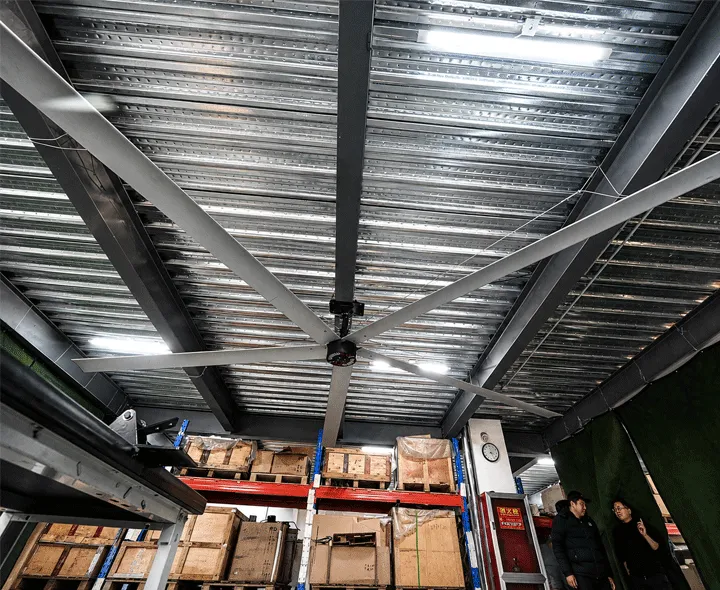
Before choosing an HVLS ceiling fan, measure the lowest roof structure, not just the highest point of a pitched roof. Also consider beams, lighting, sprinklers, cranes, ducts, and storage equipment.
The correct fan diameter and mounting position must be evaluated together.
4. How Many HVLS Fans Does a Warehouse Need?
This is one of the most common questions from warehouse owners and purchasing managers.
The number of fans cannot be determined accurately by floor area alone. Two warehouses with the same square footage may require different fan quantities because their ceiling heights, storage layouts, and operating conditions differ.
For example, consider these two facilities:
-
Warehouse A has an open floor plan with relatively few obstructions.
-
Warehouse B has tall pallet racks, multiple aisles, packing stations, and separate loading areas.
Even if both buildings have the same floor area, their airflow requirements may be very different.
When calculating the number of fans, evaluate:
-
Total building length and width.
-
-
Fan diameter and typical spacing.
-
Rack height and aisle direction.
-
Number of occupied working zones.
-
Existing HVAC supply and exhaust locations.
-
Required air movement and operating schedule.
A simple example
A large warehouse considering the P780-24 should review its published typical spacing of 75–120 ft. The final number and arrangement still depend on structural positions, rack geometry, blade clearance, and airflow performance.
Avoid simply dividing floor area by an advertised coverage figure.
A professional layout should show the location of each fan, the intended coverage zones, and the relationship between neighboring units.

HVLS Fans for Warehouses: Compare P680, P730, and P780 Industrial Ceiling Fans
5. What Technical Features Should Buyers Check in Industrial HVLS Ceiling Fans?
When comparing industrial ceiling fans, buyers should look beyond diameter and appearance.
The complete fan system includes the motor, blades, hub, mounting assembly, safety components, controller, and electrical connections.
Five-blade aerodynamic design
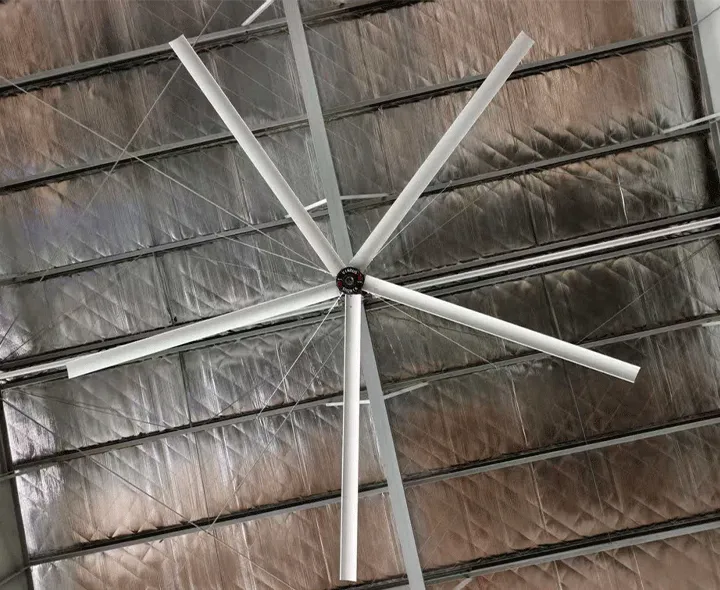
The COOL P680, P730, and P780 product families use five anodized aluminum blades.
Blade design affects how air moves through the building. Buyers should check:
-
Blade material and construction.
-
Blade attachment and retention design.
-
-
Surface treatment and corrosion resistance.
-
Manufacturer documentation and safety provisions.
A large industrial ceiling fan must withstand long operating hours and demanding industrial conditions.
Direct-drive PMSM motor technology
A direct-drive permanent magnet synchronous motor connects the motor directly to the fan assembly without a separate gearbox.
This design can reduce mechanical transmission components and eliminate routine gearbox oil changes associated with geared systems.
For warehouse operators, the key evaluation points include:
-
Rated and maximum input power.
-
-
Motor and controller specifications.
-
Maintenance requirements.
-
-
Do not compare motors based on rated power alone. Ask suppliers for complete fan performance and power information under comparable operating conditions.
Industrial protection and safety
The published P680, P730, and P780 specifications include IP55 protection, UL/ULc certification, and a three-year parts warranty, with extended warranty options. Always request the relevant current documentation for the exact model and configuration.
6. How Do HVLS Fans Work With Existing Warehouse HVAC Systems?
HVLS fans and HVAC systems perform different but complementary functions.
An HVAC system controls indoor temperature and supplies conditioned air. An HVLS fan improves air movement and helps distribute that air throughout the occupied space.
During summer, air movement across workers increases evaporative cooling and can improve perceived comfort without directly lowering the room’s air temperature.
During winter, suitable low-speed operation can help redistribute warm air that collects near the ceiling.
For warehouse managers, this means the fan system should be planned together with:
-
Air conditioning equipment.
-
-
-
-
-
The goal is to avoid airflow patterns that work against the existing HVAC system.
For example, installing a fan directly in an unsuitable position near an exhaust opening could interfere with the intended air path.
Important: HVLS fans recirculate indoor air. They do not replace required outdoor-air ventilation or local exhaust for dust, fumes, and other contaminants.
7. What Should You Check Before Industrial Ceiling Fan Installation?
Installation planning is just as important as model selection.
Large industrial fans operate above people, inventory, and equipment. Their mounting structure must support the equipment and its operating loads.
Before installation, the project team should review:
| Installation item |
What to verify |
| Roof structure |
Suitable structural attachment points |
| Soporte de montaje |
Correct model and approved configuration |
| Downrod |
Appropriate length and clearance |
| Sprinklers |
Required fire-protection clearance |
| Lighting |
No interference with blade movement |
| Electrical supply |
Correct voltage and circuit |
| Safety components |
Safety cables and blade retention |
| Maintenance access |
Safe inspection and servicing arrangements |
A qualified structural professional should review mounting loads and attachment details. Electrical work should follow applicable local requirements.
For existing warehouses, installation planning should also consider forklift traffic, operating shifts, and the need to avoid unnecessary disruption.
8. Can Intelligent Controls Improve Warehouse HVLS Fan Systems?
Yes. Intelligent controls can make multiple industrial HVLS fans easier to manage, especially in warehouses with different operating zones.
For example, receiving areas, packing stations, and bulk storage zones may have different operating schedules and comfort requirements.
The COOL FanBrain intelligent control system offers several functions:
-
Centralized control of up to 10 fans through one 10-inch HMI touchscreen.
-
Forward and reverse rotation control.
-
-
Automatic start and stop scheduling.
-
Temperature sensor integration.
-
Group control by area or workshop.
-
Modbus-RTU communication and BMS integration.
With two temperature sensors installed at roof and floor levels, the system can also support automatic reverse operation when the configured temperature difference is reached.
Explore the FanBrain intelligent HVLS control system to learn more about its control functions.

HVLS Fans for Warehouses: Compare P680, P730, and P780 Industrial Ceiling Fans
9. How Should You Evaluate an Industrial Fan Supplier?
Choosing the right fan is only part of the purchasing decision. The supplier also needs to provide reliable technical information and project support.
When comparing different industrial fan manufacturers, consider these factors:
| Evaluation criteria |
Questions to ask suppliers |
| Manufacturing capability |
Does the supplier manufacture or simply distribute fans? |
| Product specifications |
Are complete technical datasheets available? |
| Motor technology |
What motor and drive system does the fan use? |
| Seguridad |
Can the supplier provide certification documents? |
| Engineering support |
Can they review building drawings and layouts? |
| Customization |
Can mounting and control requirements be discussed? |
| Garantía |
What parts and services are covered? |
| Spare parts |
Are replacement components available? |
| After-sales service |
Is technical support available after installation? |
Why supplier experience matters
A reliable manufacturer should understand more than fan production.
It should also understand warehouse airflow, installation conditions, industrial safety, electrical requirements, and long-term maintenance.
As a Sino-US joint venture manufacturer and solution provider, COOL specializes in HVLS fans, industrial ceiling fans, commercial ceiling fans, and intelligent airflow control systems.
We work with warehouse owners, logistics companies, manufacturing plants, HVAC contractors, distributors, and international B2B buyers.
Our goal is to recommend a complete airflow solution based on the building rather than simply selling the largest available fan.
10. What Makes the Best HVLS Fans for Warehouses?
The best HVLS fans are not necessarily the biggest or most powerful models.
They are the fans that match the building’s dimensions, ceiling height, operating conditions, and budget while providing reliable long-term performance.
For a preliminary selection, consider the following:
| Warehouse project |
COOL model to evaluate |
| Medium-size warehouse |
P680 |
| Small logistics area |
P680 |
| Medium-to-large warehouse |
P730 |
| Large distribution center |
P780 |
| Large industrial warehouse |
P780 |
These are initial product-screening recommendations. Final selection requires an engineering review.
Information to prepare before requesting a quotation
To help a manufacturer recommend the right industrial ceiling fan, prepare:
-
-
Building length and width.
-
Ceiling and blade installation height.
-
Rack dimensions and storage layout.
-
-
Electrical supply information.
-
Required fan quantity, if already estimated.
-
Project location and installation requirements.
The more accurate the information, the easier it is to compare fan models and develop a suitable proposal.
You can also explore the complete COOL HVLS product range before discussing your project.
Preguntas frecuentes
What is the best HVLS fan size for a warehouse?
It depends on building height, floor layout, and required airflow. COOL offers P680 models from 8–14 ft, P730 models from 16–18 ft, and P780 models from 20–24 ft in diameter.
How many HVLS fans are needed for a 50,000 sq ft warehouse?
There is no universal number. The required quantity depends on ceiling height, storage racks, obstructions, fan diameter, and target airflow. A dimensioned building layout is needed for an accurate recommendation.
Can HVLS fans replace traditional warehouse ventilation?
No. HVLS fans circulate existing indoor air. They do not replace fresh-air supply, exhaust ventilation, or systems designed to remove contaminants.
Are direct-drive HVLS fans better than geared fans?
Direct-drive fans can reduce the number of mechanical transmission components and related maintenance tasks. However, buyers should compare complete fan performance, power consumption, safety, warranty, and lifecycle costs before deciding.
Can warehouse HVLS fans operate throughout the year?
Yes. They can support summer comfort through air movement and winter temperature destratification through appropriate low-speed operation. The operating direction and speed should follow the manufacturer’s instructions.
What information is needed to get an HVLS fan quotation?
Provide building dimensions, ceiling height, floor plan, rack layout, electrical supply, operating requirements, and project location. These details help the manufacturer recommend suitable models and quantities.
Final Thoughts: Choose the Right Warehouse HVLS Fan System
Selecting an industrial ceiling fan is an engineering and purchasing decision, not simply a product-size comparison.
The most important points to remember:
-
Start with building measurements: Floor area and ceiling height determine the initial selection.
-
Compare actual product specifications: Evaluate P680, P730, and P780 based on their diameter, power, and installation requirements.
-
Consider the complete system: Motor, blades, mounting, safety, and controls all matter.
-
Plan fan quantity carefully: Do not rely on generic coverage figures.
-
Coordinate with HVAC: HVLS fans support air circulation but do not replace ventilation systems.
-
Evaluate the manufacturer: Check engineering support, certifications, warranty, and after-sales service.
-
Plan for long-term operation: Consider energy use, maintenance access, and intelligent controls.
Looking for the right HVLS fans for your warehouse?
COOL Fans provides industrial airflow solutions for warehouses, logistics centers, manufacturing facilities, and other large industrial buildings.
Whether you are planning a new warehouse, upgrading an existing ventilation system, or sourcing industrial ceiling fans for distribution, our team can help evaluate your requirements and recommend suitable P-series configurations.
Send us your warehouse floor plan and building dimensions to discuss a suitable HVLS fan solution.
Contact COOL Fans for a Project Quotation